

Question
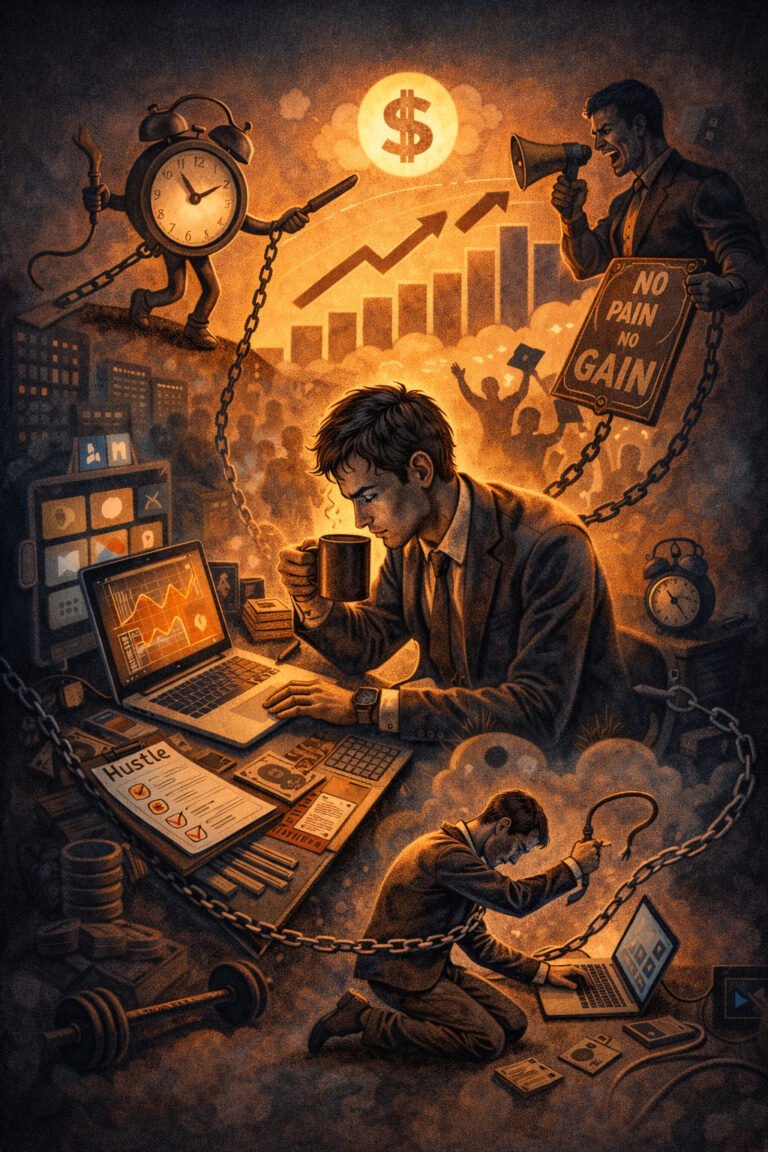
If capitalism is so exploitative, why do so many people willingly work longer hours, burn out, brag about exhaustion, and blame themselves when they fail? Are we being exploited—or are we participating in our own exhaustion?
Definition
This argument challenges a common assumption: that capitalism primarily exploits people from the outside—through bosses, corporations, or systems imposed on passive individuals. Instead, it suggests something more uncomfortable: modern capitalism increasingly relies on self-exploitation. People internalize expectations of productivity, discipline, and success so deeply that they police themselves. No one has to force them. They do it voluntarily, often proudly. The system doesn’t need a whip when it has motivation, comparison, and fear.
Five Keywords You Should Know
- Self-Exploitation – A condition where individuals push themselves beyond healthy limits, not because they are directly forced, but because they believe they should. The pressure comes from inside, shaped by cultural norms.
- Hustle Culture – A belief system that glorifies constant work, productivity, and “grind,” framing rest as laziness and overwork as virtue. It turns exhaustion into a badge of honor.
- Internalized Oppression – When external pressures and expectations become internal beliefs. People adopt the system’s values and enforce them on themselves, even when harmful.
- Productivity Identity – The fusion of personal worth with output. Instead of “I work,” it becomes “I am what I produce.” When productivity drops, self-esteem collapses.
- Responsibilization – A cultural shift where systemic problems (job insecurity, low wages, lack of safety nets) are reframed as individual failures requiring personal optimization.
A Little Bit of History
Early capitalism absolutely relied on external exploitation: long factory hours, child labor, unsafe conditions, and overt coercion. Workers had little choice and little power. Over time, labor protections, unions, and regulations reduced the most visible abuses—at least in many countries.
But capitalism didn’t disappear. It adapted. As work became more cognitive and less physically coercive, control shifted inward. Instead of factory bells, we got deadlines. Instead of overseers, we got performance metrics. Eventually, we got something even more efficient: the motivated self.
In the late 20th and early 21st centuries, especially with neoliberal ideology, responsibility was reframed. Success and failure were individualized. If you struggled, it wasn’t the system—it was your mindset, your effort, your choices. Freedom increased on paper, but so did pressure. You were “free” to succeed—and therefore personally responsible if you didn’t.
Precise, Everyday Examples
Let’s make this concrete.
Example 1: The Always-On Worker
A salaried employee checks emails at night, answers messages on weekends, and feels guilty taking vacation. No one explicitly demands this. The company culture just subtly rewards availability. Promotions go to those who “go the extra mile.” Over time, the employee internalizes the rule: rest is risky. Burnout follows, but it’s framed as a personal weakness rather than a predictable outcome.
Example 2: The Freelancer or Gig Worker
A rideshare driver or freelance designer technically has “freedom.” They choose their hours. But income is unstable, algorithms penalize inactivity, and visibility depends on constant engagement. Saying no feels dangerous. The worker pushes themselves harder than a traditional boss ever could—because survival depends on it.
Example 3: The Student-Optimizer
Students aren’t just learning anymore; they’re branding. Grades, internships, extracurriculars, LinkedIn profiles, side projects—everything becomes a metric. Rest feels unproductive. Failure feels catastrophic. Education shifts from exploration to performance, and anxiety skyrockets.
Example 4: The Wellness Trap
Even self-care becomes work. Track your sleep. Optimize your diet. Hack your productivity. Meditate not for peace, but to perform better. When exhaustion hits, the response isn’t “this system is unsustainable,” but “I need a better routine.”
In all these cases, no one is holding a gun to anyone’s head. And yet the pressure is relentless.
Current Events and Cultural Signals
Burnout is now so common it’s normalized. Terms like quiet quitting appear—not as rebellion, but as shock that people might do only what they’re paid to do. Social media celebrates entrepreneurs who sleep four hours a night, while hiding the financial cushions that made risk survivable.
At the same time, structural supports shrink. Job security declines. Housing becomes unaffordable. Healthcare is precarious. And yet the dominant narrative remains: adapt, upskill, hustle. If you fall behind, the language is moral—lazy, entitled, unmotivated.
Notice how rarely we ask whether the pace itself is reasonable.
Conclusion
So does capitalism exploit people? Historically, yes. But today, its greatest efficiency lies elsewhere. It convinces people to exploit themselves, to internalize pressure, and to confuse endurance with virtue. When control becomes internal, resistance weakens—because it feels like a personal failure rather than a systemic issue.
This doesn’t mean individuals are foolish or weak. It means the system is sophisticated. Real freedom isn’t just the absence of chains—it’s the ability to stop running without feeling worthless.
Maybe the most radical act in modern capitalism isn’t rebellion.
Maybe it’s rest.
Maybe it’s saying, “My value isn’t identical to my output.”
Quiz
- What is self-exploitation, and how does it differ from traditional forms of exploitation?
- Why does internalizing responsibility make systems of pressure harder to challenge?