

Question
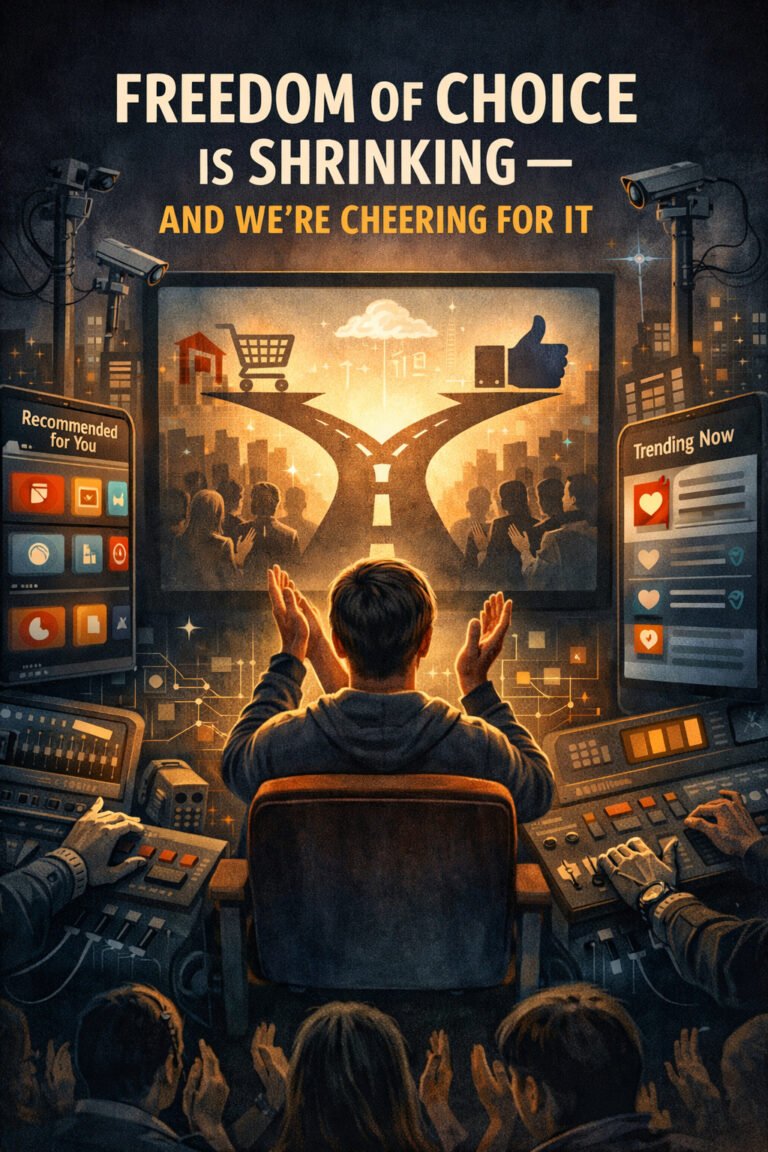
When was the last time you chose something without an algorithm helping you decide? A movie, a song, a route, a product, even a belief? And if choosing feels easier than ever… why does it also feel narrower?
Definition
Freedom of choice is the ability to make decisions based on your own values, reasoning, and preferences, without coercion or manipulation. Traditionally, freedom meant having real alternatives and the mental space to evaluate them. Today, however, many of our choices are quietly shaped in advance—filtered, ranked, suggested, and optimized for us. We still “choose,” but increasingly from menus designed by systems that know our habits better than we do. The result is an illusion of autonomy: we feel free, even as our decision-making is subtly guided.
Five Keywords You Should Know
- Algorithmic Nudging – The practice of steering behavior through data-driven suggestions. Think of recommendations that don’t force you to act, but gently push you toward certain choices. You’re not ordered—just guided.
- Choice Architecture – The way options are structured and presented. What appears first, what’s hidden, what’s default. Small design decisions can massively influence outcomes without removing choice outright.
- Soft Authoritarianism – A form of control that doesn’t rely on violence or overt repression. Instead, it works through convenience, incentives, and “best practices,” making compliance feel natural or even desirable.
- Surveillance Capitalism – An economic system where personal data is collected, analyzed, and monetized to predict and shape behavior. Your attention and future actions become the product.
- Autonomy – The capacity to self-govern: to think, choose, and act according to your own principles. Autonomy weakens when decisions are outsourced—even willingly—to systems optimized for efficiency, not meaning.
A Little Bit of History
Classically, freedom was about political liberty—freedom from kings, tyrants, and coercive states. Later, especially in liberal capitalist societies, freedom became closely tied to consumer choice: the more options you had, the freer you were. Supermarkets replaced monarchs as symbols of liberty.
But something shifted with the rise of digital technology. Choice exploded in quantity, yet decision-making was outsourced. As information overload grew, tools emerged to help us choose faster. Search engines ranked truth. Platforms curated relevance. Convenience slowly replaced deliberation. We didn’t lose freedom overnight—we traded pieces of it for comfort, speed, and cognitive relief. And honestly? It felt like a good deal.
Current Events and Everyday Examples
Look around. Your social media feed isn’t neutral—it’s personalized. News, opinions, and even outrage are selected to keep you engaged. Streaming platforms decide what you’re “most likely to enjoy,” often narrowing exploration rather than expanding it. Navigation apps choose routes not just based on distance, but on efficiency metrics that quietly standardize behavior.
Even politics isn’t immune. Voters are targeted with tailored messages, not shared debates. Two people can live in the same country yet inhabit entirely different informational realities. And still, most of us don’t protest this. Why? Because it’s convenient. Because thinking is exhausting. Because being guided feels safer than being lost.
We’re not forced. We’re optimized.
Conclusion
Here’s the uncomfortable part: we’re not just losing freedom of choice—we’re applauding it. We celebrate “smart” systems that decide for us, forgetting that every outsourced decision weakens a muscle. Autonomy, like any skill, atrophies when unused.
This isn’t a warning about evil machines or secret plots. It’s about trade-offs. When life becomes frictionless, meaning can thin out. When every choice is pre-filtered, curiosity shrinks. Real freedom isn’t about infinite options—it’s about conscious selection. And that requires effort, slowness, and sometimes discomfort.
So maybe the question isn’t “Are we still free?”
Maybe it’s: How much freedom are we willing to give up just to feel comfortable?
Quiz
- What is “soft authoritarianism,” and how does it differ from traditional authoritarianism?
Why can having more choices actually reduce autonomy in practice?