

Introduction
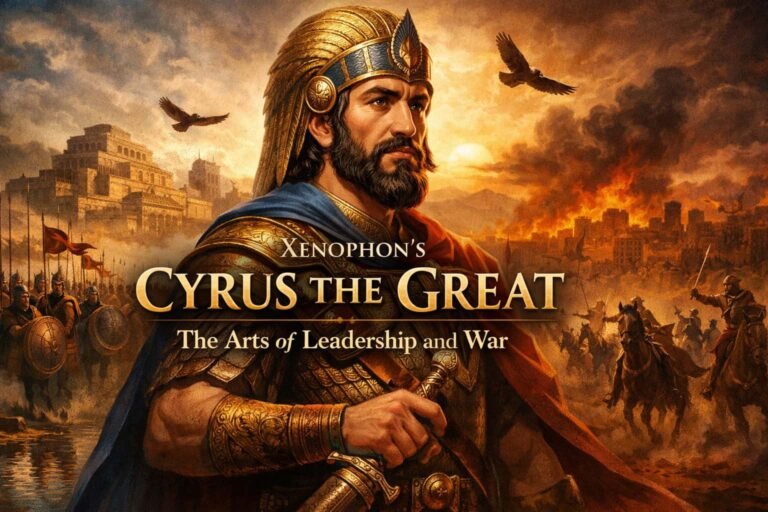
Few figures in ancient history have captured the imagination of political thinkers quite like Cyrus the great. In Xenophon’s Cyrus the Great: The Arts of Leadership and War, the Greek historian and soldier Xenophon offers more than a biography—he presents a vivid exploration of ideal leadership through the life of one of history’s most successful empire builders. Written as both historical narrative and philosophical reflection, the book examines how Cyrus the great rose from Persian prince to ruler of a vast, multicultural empire, emphasizing the personal qualities, strategies, and ethical principles that enabled his success.
- Introduction
- Brief Overview of the Book
- Why This Book Matters
- About the Author: Xenophon
- Historical and Cultural Context
- Book I: The Education and Formation of Cyrus
- Book II: Cyrus’s Entry into Leadership and Military Reform
- Book III: Diplomacy, Discipline, and Strategic Thinking
- Book IV: Innovation, Adaptability, and the Art of Command
- Book V: Leadership Through Generosity and Justice
- Book VI: The Moral Responsibilities of Absolute Power
- Book VII: The Conquest of Babylon and Peak of Power
- Book VIII: Cyrus as the Ideal Ruler and the Fragility of Legacy
- Main Themes and Key Concepts
- Why This Book Is Still Relevant Today
- Conclusion
- Frequently Asked Questions (FAQ)
This work matters not only for its historical content but also for its lasting influence on ideas of leadership, governance, and military command. Readers searching for insight into ancient leadership models, political wisdom, and the enduring legacy of Cyrus the great will find Xenophon’s account both engaging and surprisingly relevant today.
Brief Overview of the Book
Xenophon’s Cyrus the Great, often referred to as the Cyropaedia, is a semi-historical narrative that blends fact, idealization, and philosophical instruction. Xenophon uses the life of Cyrus the great as a framework to explore how leaders can gain loyalty, maintain discipline, and rule justly while wielding immense power.
Rather than offering a strict historical chronicle, the book functions as a leadership manual disguised as a story. Xenophon examines education, moral character, persuasion, military organization, and political intelligence through the actions and decisions of Cyrus. The result is a compelling narrative that reads like both an epic tale and a guide to effective rule.
Why This Book Matters
This book matters because it asks timeless questions:
- What makes a leader truly effective?
- How can power be exercised without cruelty?
- Can military success coexist with justice and moderation?
Through the figure of Cyrus the great, Xenophon presents a model of leadership based on self-control, respect for others, adaptability, and strategic thinking. These ideas influenced later thinkers from Roman emperors to Renaissance political theorists and continue to resonate in modern discussions of leadership and ethics.
About the Author: Xenophon
A Brief Biography
Xenophon was a Greek historian, soldier, philosopher, and student of Socrates, born around 430 BCE in Athens. He lived through a period of political instability and warfare, experiences that deeply shaped his thinking about leadership and governance. Xenophon participated in military campaigns, most famously chronicled in his work Anabasis, which recounts a perilous march of Greek mercenaries through hostile territory.
Context Relevant to the Book’s Themes
Xenophon admired strong, capable leaders who combined intelligence with moral discipline. His exposure to Persian culture and governance—unusual for a Greek of his time—gave him a broader perspective on leadership beyond the Greek city-state model. In Cyrus the great, Xenophon found the perfect subject to explore how authority, virtue, and strategy could coexist on an imperial scale.
Historical and Cultural Context
When and Why the Book Was Written
The Cyropaedia was written in the early 4th century BCE, long after the death of Cyrus the great, who ruled in the 6th century BCE. Xenophon was less concerned with strict historical accuracy than with illustrating principles of leadership. His Cyrus is an idealized ruler, shaped to demonstrate how power can be gained and maintained through wisdom rather than fear.
Social, Political, and Philosophical Influences
Greek political life was marked by factionalism and short-lived leadership. In contrast, the Persian Empire under Cyrus the great appeared stable, expansive, and orderly. Xenophon used this contrast to question Greek assumptions about freedom, authority, and governance. Socratic philosophy also influenced the book, particularly its emphasis on self-mastery and ethical conduct as the foundation of leadership.
Book I: The Education and Formation of Cyrus
The first book lays the foundation for everything that follows by focusing on the education and early character formation of Cyrus the great. Xenophon begins by describing Persian society, especially its public system of education, which emphasizes justice, discipline, obedience to law, and self-control. From the beginning, leadership is framed not as innate privilege but as the product of structured moral training.
Cyrus is introduced as the son of Cambyses, a Persian king, and Mandane, a Median princess. This mixed heritage becomes crucial. As a boy in Persia, Cyrus learns strict discipline and equality under the law. Children are taught to value moderation, honesty, and service to the community. Xenophon stresses that Cyrus thrives in this system, showing an early inclination toward fairness and leadership.
When Cyrus travels to Media to live with his grandfather Astyages, he encounters a very different culture—one of luxury, hierarchy, and indulgence. Rather than being corrupted by comfort, Cyrus learns to navigate both worlds. He enjoys luxury but does not become dependent on it. Xenophon uses this contrast to show how Cyrus the great develops balance: he understands pleasure without being ruled by it.
Several episodes highlight young Cyrus’s natural authority. He wins games not through force but persuasion, settles disputes among other children, and instinctively seeks fairness. Xenophon emphasizes that Cyrus gains obedience because people trust his judgment, not because he demands submission.
By the end of Book I, Cyrus emerges as a young man uniquely prepared for leadership—disciplined, confident, empathetic, and adaptable. Xenophon makes clear that great leadership begins long before power is formally granted.
Book II: Cyrus’s Entry into Leadership and Military Reform
Book II marks Cyrus the great’s transition from student to leader. As tensions rise between Media, Persia, and neighboring enemies, Cyrus is given his first opportunity to command troops. Xenophon focuses on how Cyrus earns authority rather than assuming it.
Cyrus immediately distinguishes himself by reforming military organization. He recognizes that traditional Persian practices reward age and status more than merit. Instead, he promotes discipline, training, and competence. Soldiers are grouped and trained in ways that encourage cooperation and mutual responsibility.
One of the book’s central lessons is motivation. Cyrus understands that people fight best when they believe their efforts matter. He introduces systems of recognition, honor, and shared reward. Xenophon repeatedly shows Cyrus speaking to soldiers not as inferiors but as partners in a common cause.
Cyrus also demonstrates logistical intelligence. He ensures supplies, training schedules, and command structures are clear and efficient. Xenophon contrasts this preparation with the disorder of enemy forces, reinforcing the idea that success is built before battles begin.
Book II establishes Cyrus as a leader who understands human psychology. He motivates not through fear but through hope, pride, and shared purpose. Xenophon presents this as a crucial reason why Cyrus the great inspires loyalty so quickly.
Book III: Diplomacy, Discipline, and Strategic Thinking
In Book III, Cyrus begins engaging in more complex political and military situations. He faces allies who must be managed carefully and enemies who must be confronted without unnecessary cruelty. Xenophon highlights Cyrus’s growing skill in diplomacy and strategic foresight.
Cyrus demonstrates that leadership involves restraint. Rather than rushing into battle, he studies terrain, enemy habits, and political relationships. Xenophon emphasizes that Cyrus values intelligence gathering and planning over brute force.
A major focus is Cyrus’s treatment of allies. He honors agreements, distributes rewards fairly, and avoids humiliating those who serve him. By doing so, he creates voluntary loyalty rather than forced obedience. Xenophon suggests that this approach builds a stronger and more stable coalition.
Discipline is another key theme. Cyrus enforces rules consistently but not harshly. Punishments are framed as corrective rather than vindictive. Xenophon shows that soldiers respect Cyrus because his decisions feel just, even when strict.
By the end of Book III, Cyrus the great is no longer merely a promising leader—he is a strategic thinker who understands that wars are won as much through relationships and planning as through combat.
Book IV: Innovation, Adaptability, and the Art of Command
Book IV focuses on Cyrus as a military innovator. Faced with varied enemies and terrains, he adapts tactics rather than relying on tradition. Xenophon uses these episodes to explore adaptability as a core leadership virtue.
Cyrus reorganizes his forces to increase efficiency and morale. He encourages initiative among officers while maintaining clear chains of command. Xenophon highlights his ability to delegate authority without losing control.
A key lesson in this book is that leaders must be learners. Cyrus the great observes enemy tactics and incorporates useful elements into his own army. Xenophon contrasts this openness with leaders who fail because they cling rigidly to outdated methods.
The book also emphasizes emotional control. Cyrus remains calm under pressure, modeling the behavior he expects from others. Xenophon suggests that a leader’s emotional state sets the tone for the entire organization.
Book IV reinforces the idea that effective command is dynamic, not static. Cyrus succeeds because he evolves with circumstances while remaining grounded in core principles.
Book V: Leadership Through Generosity and Justice
Book V shifts focus from battlefield tactics to governance and human relationships. As Cyrus’s power expands, Xenophon examines how he manages success without arrogance.
Cyrus becomes known for generosity—but not reckless generosity. Rewards are given based on merit, loyalty, and service. Xenophon emphasizes that fairness in distribution prevents jealousy and resentment, common causes of internal collapse.
Cyrus also demonstrates deep emotional intelligence. He remembers names, listens to grievances, and acknowledges individual contributions. These actions may seem small, but Xenophon presents them as powerful tools for maintaining loyalty.
The book explores Cyrus’s interactions with conquered peoples. Rather than imposing uniform customs, he allows local traditions to continue as long as they do not threaten stability. This respect for diversity strengthens his rule.
Book V shows Cyrus the great as a ruler who understands that power must feel beneficial to those who live under it. Governance, Xenophon suggests, is sustained through trust.
Book VI: The Moral Responsibilities of Absolute Power
Book VI delves into the ethical dimensions of leadership. Xenophon uses Cyrus’s reflections and decisions to explore the dangers of power unchecked by virtue.
Cyrus repeatedly emphasizes self-discipline. He avoids excess in food, pleasure, and luxury, believing that indulgence weakens judgment. Xenophon portrays this restraint as essential to maintaining authority.
Justice is examined in depth. Cyrus insists that laws apply consistently, including to those close to him. Xenophon presents this impartiality as a cornerstone of legitimacy.
The book also addresses leadership fatigue and temptation. Cyrus recognizes that success can breed complacency and arrogance. Xenophon uses this awareness to reinforce his message: great leadership requires constant vigilance.
Book VI positions Cyrus the great as not only a conqueror but a moral guardian of his empire.
Book VII: The Conquest of Babylon and Peak of Power
Book VII represents the climax of the narrative: the conquest of Babylon. Xenophon presents this event as a masterclass in strategy rather than a display of raw force.
Cyrus uses intelligence, deception, and timing to achieve victory with minimal destruction. Xenophon emphasizes that restraint during victory is as important as courage during conflict.
After the conquest, Cyrus carefully manages the transition of power. He preserves institutions, respects religious practices, and avoids unnecessary punishment. These actions prevent rebellion and stabilize the empire.
This book portrays Cyrus the great at the height of his abilities—commanding immense power while maintaining control, justice, and foresight.
Book VIII: Cyrus as the Ideal Ruler and the Fragility of Legacy
The final book reflects on Cyrus’s reign and character as a whole. Xenophon presents him as the embodiment of ideal leadership: disciplined, just, generous, and strategically brilliant.
Cyrus organizes his empire efficiently, delegating authority while maintaining unity. Xenophon emphasizes that systems alone are not enough—Cyrus’s personal character remains central to stability.
The book ends with a subtle warning. After Cyrus’s death, the empire begins to decline. Xenophon implies that institutions cannot fully replace virtuous leadership. The loss of Cyrus’s personal example leads to moral and political decay.
This conclusion reinforces Xenophon’s central argument: great leadership is rare, fragile, and deeply personal.
Main Themes and Key Concepts
Leadership as Moral Discipline
A central theme of the book is that leadership begins with self-mastery. Cyrus the great succeeds because he controls his desires, emotions, and ambitions. Xenophon argues that those who cannot govern themselves cannot govern others.
Cyrus demonstrates that leaders gain loyalty by sharing hardship with their followers rather than isolating themselves in comfort.
Power Through Persuasion, Not Fear
Xenophon repeatedly contrasts coercive rule with persuasive leadership. Cyrus earns loyalty by respecting others, keeping promises, and rewarding service. His authority feels legitimate because it aligns with shared values.
Cyrus demonstrates that leaders gain loyalty by sharing hardship with their followers rather than isolating themselves in comfort.
Adaptability and Intelligence
Another key theme is adaptability. Cyrus the great adjusts strategies, policies, and behaviors to suit circumstances. Xenophon presents flexibility as a strength, not a weakness, in both war and governance.
He shows that preparation and foresight prevent conflict and reduce suffering.
Unity in Diversity
Cyrus’s empire includes many cultures, languages, and traditions. Xenophon highlights his ability to unify diversity under a common political order without enforcing uniformity. This inclusive approach strengthens stability and loyalty.
Cyrus illustrates that generosity, when combined with fairness, strengthens authority rather than diminishing it.
Education and Habit
Education is treated not as abstract learning but as the formation of habits. Xenophon emphasizes training in justice, endurance, and cooperation as foundations of leadership.
Law and Custom
Cyrus respects laws and customs, even when he has the power to ignore them. This respect reinforces legitimacy and social order, highlighting the importance of institutions alongside individual virtue.
Why This Book Is Still Relevant Today
At its core, the book argues that effective leadership depends on character as much as competence. Cyrus the great succeeds not simply because he conquers territories but because he understands people.
Xenophon suggests that political stability arises when leaders align personal ambition with collective well-being. The ideal ruler is not free from desire but disciplined enough to direct it wisely.
Modern leaders face challenges strikingly similar to those Xenophon describes: managing diverse populations, balancing authority with accountability, and maintaining ethical standards under pressure.
Cyrus the great offers a timeless case study in leadership that values empathy, discipline, and strategic intelligence. In an age of rapid change and global complexity, Xenophon’s insights remain remarkably applicable.
In antiquity, Xenophon’s work was widely read and admired. It influenced Greek and Roman ideas about kingship and leadership, serving as a reference point for discussions of power and virtue.
The book shaped political thought for centuries. Roman leaders, Renaissance thinkers, and early modern philosophers studied Cyrus the great as a model ruler. Even today, leadership training programs echo Xenophon’s emphasis on character, vision, and persuasion.
Conclusion
Xenophon’s Cyrus the Great: The Arts of Leadership and War is more than an ancient biography—it is a profound meditation on power, character, and responsibility. Through the life of Cyrus the great, Xenophon presents a vision of leadership grounded in self-control, respect for others, and thoughtful strategy.
For readers seeking to understand not just how empires are built but how they can be governed wisely, this book offers enduring lessons. Its blend of narrative and insight invites reflection, making it a cornerstone work for anyone interested in leadership, history, or political philosophy.
Frequently Asked Questions (FAQ)
What is Xenophon’s Cyrus the Great about?
It is a narrative and philosophical exploration of leadership using the life of cyrus the great as an ideal model of political and military authority.
Is the book historically accurate?
The book is based on historical events but is intentionally idealized. Xenophon prioritizes moral and leadership lessons over strict historical detail.
Why is cyrus the great important in leadership studies?
Cyrus represents a ruler who combined strategic brilliance with ethical conduct, making him a lasting example of effective and humane leadership.
What are the main themes of the book?
Key themes include self-discipline, persuasive leadership, adaptability, justice, and the ethical use of power.
Is this book relevant for modern readers?
Yes. Its insights into leadership, governance, and human motivation remain applicable in modern political, organizational, and personal leadership contexts.