
A Comprehensive Summary
Introduction:
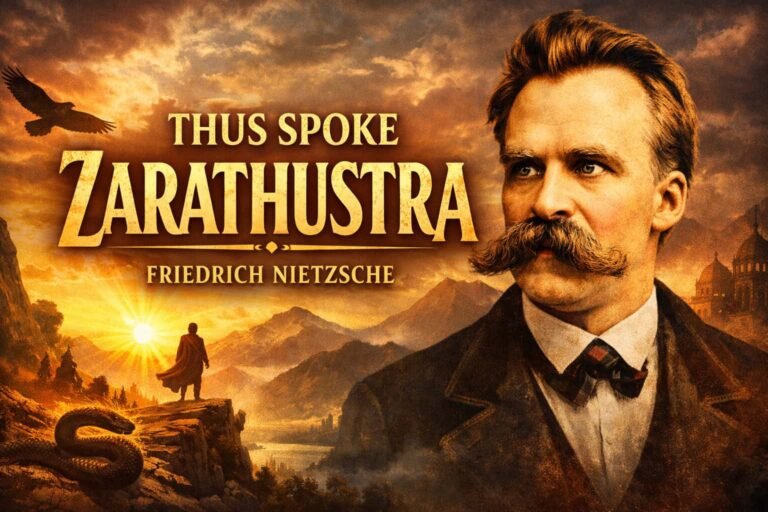
Zarathustra is not merely the name of a character—it is the voice through which Friedrich Nietzsche delivers one of the most provocative philosophical works ever written. Thus Spoke Zarathustra is a poetic, symbolic, and often challenging book that explores what it means to live fully in a world without absolute truths. Through the teachings of Zarathustra, Nietzsche confronts religion, morality, culture, and the individual’s responsibility to create meaning. This in-depth summary of Zarathustra is designed for readers seeking a clear, engaging, and comprehensive understanding of the book’s ideas, themes, and enduring relevance.
Brief Overview of the Book
Thus Spoke Zarathustra was published in four parts between 1883 and 1885. Rather than a conventional novel or philosophy treatise, it is written as a series of sermons, parables, and poetic discourses delivered by the prophet-like figure Zarathustra. Inspired by the ancient Persian religious founder Zoroaster, Nietzsche reimagines Zarathustra as a thinker who descends from solitude to teach humanity new values.
The book addresses fundamental questions: What happens when traditional beliefs lose their power? How should individuals live when old moral systems collapse? Nietzsche’s answer unfolds through Zarathustra’s teachings about self-overcoming, creative power, and the challenge of becoming something greater than what humanity has been so far.
Why Zarathustra Matters
Zarathustra matters because it confronts the crisis of meaning in modern life. Nietzsche believed Western culture was entering an era where inherited religious and moral frameworks no longer convinced people. This vacuum, he warned, could lead to nihilism—life feeling empty and purposeless.
Zarathustra offers an alternative: rather than clinging to outdated values, individuals must take responsibility for creating their own. The book continues to resonate because it speaks directly to modern struggles with identity, purpose, conformity, and freedom.
About Friedrich Nietzsche
A Short Biography
Friedrich Nietzsche was born in 1844 in Prussia (modern-day Germany). Trained as a classical philologist, he became one of the youngest professors in his field before turning increasingly toward philosophy. Plagued by illness and isolation, Nietzsche produced many of his most influential works outside academic institutions.
Context Relevant to Zarathustra
Nietzsche wrote Thus Spoke Zarathustra during a period of intense creativity. He had broken with many of his intellectual influences and was developing ideas that would later define his legacy. Zarathustra represents Nietzsche’s attempt to express philosophy not through systematic argument, but through myth, metaphor, and psychological insight.
Historical and Cultural Context
When and Why the Book Was Written
Thus Spoke Zarathustra was written in the late 19th century, a time of rapid scientific advancement, declining religious authority, and social change in Europe. Traditional Christian beliefs were increasingly questioned, and Nietzsche believed society had not yet reckoned with the consequences of this shift.
Philosophical Influences
Nietzsche drew on ancient Greek philosophy, Eastern traditions, and his critique of Christianity. By choosing Zarathustra—a historical religious figure—as his mouthpiece, Nietzsche symbolically reversed the origins of moral dualism, using a prophet to announce the need to go beyond prophets.
Why Zarathustra Is Still Relevant Today
Modern readers face many of the same challenges Nietzsche identified: loss of shared meaning, pressure to conform, and anxiety about identity. Zarathustra speaks to anyone questioning inherited norms and seeking authenticity.
In an age of social media, mass culture, and ideological conflict, Zarathustra’s insistence on self-reflection and creative independence feels especially urgent.
Impact and Legacy of Zarathustra
Initially, Thus Spoke Zarathustra sold poorly and puzzled readers. Its unconventional style and radical ideas limited its early audience.
Over time, Zarathustra became one of Nietzsche’s most influential works. It shaped existentialism, modern psychology, literature, and art. Thinkers such as Heidegger, Jung, and Camus engaged deeply with its ideas.
Why We Should Read Zarathustra
Zarathustra is not an easy book, but it is a rewarding one. It does not provide simple answers; instead, it provokes deeper questions about who we are and who we might become. Whether approached as philosophy, literature, or personal challenge, Thus Spoke Zarathustra invites readers to confront life with courage, creativity, and honesty.
For those willing to engage with its symbolism and ideas, Zarathustra remains a powerful companion on the path of self-discovery.
A Four-Part Summary of Thus Spoke Zarathustra
Thus Spoke Zarathustra is intentionally divided into four parts, each marking a distinct stage in Zarathustra’s intellectual and spiritual journey. These parts are not chapters in a conventional story but phases of transformation—both for Zarathustra and for the reader.
Each part of Zarathustra represents a stage:
- Proclamation of new values
- Conflict with society (confrontation)
- Inner transformation
- Letting go of followers (solitude and affirmation)
Together, they form a complete arc of growth, struggle, and affirmation.
What follows is a comprehensive summary of each part, explaining what happens, what Zarathustra teaches, and why each stage matters in the overall meaning of the book.
Part One: Zarathustra’s Descent and the Announcement of New Values
Zarathustra Leaves the Mountain
Part One begins with Zarathustra after ten years of solitude in the mountains. He has lived apart from society, contemplating life, humanity, and meaning. Like the sun that grows full and must give its light away, Zarathustra feels an inner necessity to descend among people. This descent is symbolic: wisdom must be tested in the world, not preserved in isolation.
Zarathustra does not descend out of compassion alone, but out of overflowing strength. He believes he has something urgent to say to humanity.
The First Teaching: Humanity Is a Bridge
When Zarathustra addresses the people in the marketplace, he immediately challenges their self-satisfaction. He tells them that the human being is not a finished creation but a bridge between what has been and what could be. Humanity’s greatness lies not in comfort or stability, but in its capacity to overcome itself.
This is where Zarathustra introduces his most famous idea: the Übermensch. He presents it not as a ruler over others, but as a future type of human being who creates values instead of inheriting them. The Übermensch represents growth, creativity, courage, and affirmation of life.
The crowd, however, misunderstands him. They laugh, mock, and demand entertainment rather than transformation. Zarathustra realizes that the masses are not ready.
The Last Man vs. the Higher Human
To show what humanity risks becoming, Zarathustra describes the Last Man—a figure who seeks only comfort, safety, and pleasure. The Last Man avoids struggle, ambition, and risk. Ironically, the crowd applauds this image, revealing their own smallness.
This moment establishes one of the book’s central conflicts:
- Striving vs. comfort
- Creation vs. consumption
- Growth vs. stagnation
Disappointed but undeterred, Zarathustra decides to seek companions rather than followers.
Critique of Traditional Morality
As Part One continues, Zarathustra delivers a series of speeches targeting traditional virtues and social ideals. He questions ideas like self-denial, obedience, humility, and moral purity, suggesting that many so-called virtues arise from fear or weakness rather than strength.
Zarathustra emphasizes:
- The body as wisdom, not something sinful or inferior
- Instincts as life-affirming forces
- The danger of suppressing one’s drives in the name of morality
Rather than denying oneself, Zarathustra urges self-mastery and transformation.
Friendship, Solitude, and the Path of the Individual
Zarathustra speaks about friendship as something demanding rather than comforting. A true friend challenges and pushes one toward growth. He also insists that anyone seeking to follow him must first learn to walk alone.
By the end of Part One, Zarathustra has fully established his role: not a savior, not a lawgiver, but a provoker of transformation.
Part Two: Zarathustra Confronts Society and Its Illusions
Return to the World with Sharper Vision
In Part Two, Zarathustra re-enters society more frequently. Unlike Part One, which focused on announcing ideas, this section shows him testing those ideas against real human types.
He encounters priests, scholars, politicians, artists, and so-called virtuous people. Each encounter reveals how deeply people cling to appearances and moral justifications.
The Priests and Moral Power
Zarathustra harshly criticizes religious figures, accusing them of turning weakness into virtue. He suggests that morality often becomes a tool for controlling others by glorifying guilt, obedience, and self-sacrifice.
Religion, in Zarathustra’s view, teaches people to turn against life instead of embracing it.
The Scholars and the Illusion of Objectivity
Zarathustra also mocks scholars who claim neutrality and objectivity. He sees them as people who dissect life instead of living it. Knowledge, when separated from passion and creativity, becomes sterile.
This critique is not anti-intellectual—it is anti-lifeless knowledge.
The Problem of Pity
One of the most controversial aspects of Part Two is Zarathustra’s rejection of pity. He argues that pity often traps both the giver and the receiver in weakness. Instead of helping others grow, pity may reinforce their suffering.
Zarathustra insists that strength should inspire strength, not dependency.
Loneliness and Misunderstanding
As Zarathustra continues to speak, he becomes increasingly isolated. Even those who admire him misunderstand his message, turning it into another belief system rather than a challenge to think independently.
Part Two ends with Zarathustra realizing that being ahead of one’s time is a lonely fate.
Part Three: Eternal Recurrence and Zarathustra’s Inner Crisis
The Heaviest Thought
Part Three is the philosophical and emotional center of Zarathustra. Here, Nietzsche introduces the idea of eternal recurrence—the thought that everything that happens will happen again, endlessly, in the same sequence.
This idea is not presented as a scientific theory, but as a test of one’s attitude toward life.
Zarathustra’s Struggle
Unlike earlier teachings, eternal recurrence deeply troubles Zarathustra himself. He experiences dread, silence, and inner resistance. The thought forces him to confront whether he truly affirms life—or secretly resents it.
To accept eternal recurrence means saying “yes” to:
- Every joy
- Every failure
- Every pain
without wishing anything to be different.
Overcoming the Spirit of Revenge
Zarathustra identifies revenge against time as humanity’s deepest resentment—the refusal to accept what has happened. Eternal recurrence demands reconciliation with the past, not justification or blame.
This marks Zarathustra’s greatest internal transformation.
Affirmation of Life
By the end of Part Three, Zarathustra emerges changed. He no longer merely teaches self-overcoming; he embodies it. He learns to laugh, dance, and affirm existence as it is.
This part ends not with certainty, but with strength through acceptance.
Part Four: The Higher Men and the Final Separation
Meeting the Higher Men
In Part Four, Zarathustra encounters several “higher men”—figures who represent advanced but incomplete forms of humanity. They include thinkers, artists, moralists, and spiritual seekers.
They admire Zarathustra and see him as a leader.
Why the Higher Men Fall Short
Despite their accomplishments, these men still cling to old ideals:
- Moral superiority
- Guilt
- Need for recognition
- Fear of chaos
Zarathustra realizes that even admiration can be a form of dependence.
The Final Lesson: Let Go of the Teacher
Zarathustra ultimately withdraws from the higher men. His final act is not to lead but to depart. True transformation cannot be taught—it must be lived.
The book ends with Zarathustra alone again, ready for further becoming.
What Thus Spoke Zarathustra Is Really Saying
At its core, Zarathustra argues that meaning is not discovered but created. Nietzsche rejects passive acceptance of inherited beliefs and challenges readers to become active participants in shaping their lives.
Some read Zarathustra as a spiritual text without God, others as psychological insight into human motivation. Still others see it as a cultural critique. Its openness is intentional, encouraging personal engagement rather than dogma.
Main Themes, Key Concepts and Symbolism
The Übermensch
The Übermensch is not a tyrant or superhero but a symbol of human potential. Zarathustra presents this figure as someone who creates values, embraces life, and overcomes internal limitations.
The Death of God
Although not introduced for the first time in Zarathustra, the “death of God” underlies the entire book. It signifies the collapse of absolute moral authority, forcing humanity to confront its freedom—and responsibility.
Self-Overcoming
Zarathustra repeatedly stresses the importance of overcoming oneself rather than dominating others. Growth comes from confronting fear, doubt, and complacency.
Eternal Recurrence
Eternal recurrence serves as both a thought experiment and an ethical test. It asks whether one can affirm life fully, without wishing any part of it away.
Zarathustra Himself
Zarathustra symbolizes the philosopher as creator and destroyer of values. He is both teacher and learner, embodying the process of transformation.
The Rope and the Abyss
Humanity is described as a rope stretched between animal and Übermensch, suspended over an abyss. This image highlights risk, transition, and uncertainty.
Animals and Nature
Animals often represent instinct, honesty, and alignment with life, contrasting with human self-deception and moral rigidity.
Important Ideas
- Humanity clings to comfort rather than striving for greatness.
- Traditional morality often arises from weakness, not strength.
- True freedom requires creating one’s own values.
- Loving life means embracing suffering as part of growth.
These ideas appear repeatedly throughout Zarathustra, reinforcing its call for transformation.
Frequently Asked Questions About Zarathustra
What is Thus Spoke Zarathustra about in simple terms?
Zarathustra is about a thinker who teaches people to create their own values and live fully after traditional beliefs lose their authority.
Is Zarathustra a religious book?
No. While it uses religious language and imagery, Zarathustra critiques religion and promotes individual meaning-making instead of faith.
What does the Übermensch mean?
The Übermensch represents a person who overcomes limitations, creates values, and affirms life without relying on external moral systems.
Why is Zarathustra written in a poetic style?
Nietzsche believed poetry and metaphor could express philosophical truths more powerfully than logical argument alone.
Is Zarathustra still worth reading today?
Yes. Its exploration of meaning, individuality, and self-overcoming remains highly relevant in modern life.