

Introduction
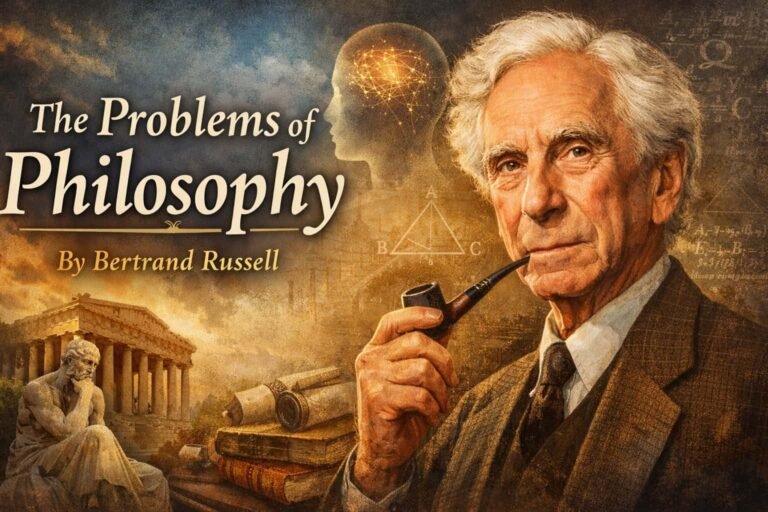
The Problems of Philosophy is one of the most influential introductions to philosophical thinking ever written. First published in 1912, Bertrand Russell’s concise yet profound book invites readers to examine how we know what we know—and whether we can ever be certain of it. Within the first few pages, The Problems of Philosophy challenges everyday assumptions about reality, knowledge, truth, and belief, offering a clear and engaging gateway into some of the deepest questions human beings have ever asked.
- Introduction
- Brief Overview of the Book
- Why The Problems of Philosophy Matters
- About Bertrand Russell
- Historical and Cultural Context
- Chapter 1: Appearance and Reality
- Chapter 2: The Existence of Matter
- Chapter 3: The Nature of Matter
- Chapter 4: Idealism
- Chapter 5: Knowledge by Acquaintance and Knowledge by Description
- Chapter 6: On Induction
- Chapter 7: On Our Knowledge of General Principles
- Chapter 8: How A Priori Knowledge Is Possible
- Chapter 9: The World of Universals
- Chapter 10: On Our Knowledge of Universals
- Chapter 11: On Intuitive Knowledge
- Chapter 12: Truth and Falsehood
- Chapter 13: Knowledge, Error, and Probable Opinion
- Chapter 14: The Limits of Philosophical Knowledge
- Chapter 15: The Value of Philosophy
- Main Themes and Key Concepts
- Important Ideas
- Why The Problems of Philosophy Is Still Relevant Today
- Conclusion
- Frequently Asked Questions
This article provides a comprehensive, reader-friendly, and in-depth summary of The Problems of Philosophy, optimized for those seeking genuine understanding rather than academic abstraction. Whether you are encountering Russell for the first time or revisiting his ideas, this guide explores the book’s arguments, themes, historical background, and enduring relevance.
Brief Overview of the Book
The Problems of Philosophy is a short philosophical work that addresses fundamental questions in epistemology (the study of knowledge) and metaphysics (the study of reality). Rather than presenting rigid answers, Bertrand Russell emphasizes the value of philosophical inquiry itself. He explores issues such as:
- The reliability of sense perception
- The distinction between appearance and reality
- The nature of knowledge and belief
- The role of logic and reason
- The limits of human certainty
The book does not require prior philosophical training. Russell deliberately avoids technical jargon, making the work accessible to general readers while remaining intellectually rigorous.
Why The Problems of Philosophy Matters
More than a century after its publication, The Problems of Philosophy remains essential reading because it teaches readers how to think rather than what to think. Russell argues that philosophy expands the mind, reduces dogmatism, and deepens our understanding of the world—even when definitive answers remain elusive.
For modern readers navigating misinformation, scientific uncertainty, and competing worldviews, Russell’s insistence on clarity, skepticism, and intellectual humility feels especially relevant.
About Bertrand Russell
Short Biography
Bertrand Russell (1872–1970) was a British philosopher, logician, mathematician, historian, and social critic. He is widely regarded as one of the founders of analytic philosophy, a movement that emphasized logical clarity and linguistic precision.
Russell was born into an aristocratic family and educated at Cambridge University, where he later became a fellow. Over his long life, he wrote more than 70 books and thousands of essays on philosophy, politics, education, and ethics.
By the time he wrote The Problems of Philosophy, Russell was deeply engaged in debates about knowledge, logic, and science. He sought to clarify philosophical problems using methods inspired by mathematics and scientific reasoning. His goal was not to mystify philosophy but to make it a disciplined, rational inquiry accessible to thoughtful readers.
Historical and Cultural Context
When and Why the Book Was Written
The Problems of Philosophy was published in 1912, during a period of rapid scientific advancement and intellectual upheaval. Traditional religious certainties were being challenged by developments in physics, biology, and psychology. At the same time, philosophers were reexamining long-standing assumptions about truth and reality.
Russell wrote the book partly as an educational text and partly as a defense of philosophy’s value in a scientifically oriented age. He wanted to show that philosophy remained essential, even when it could not provide absolute answers.
Philosophical Influences
Russell engages with and responds to major philosophical figures, including:
- René Descartes (skepticism and certainty)
- John Locke and George Berkeley (empiricism)
- Immanuel Kant (the limits of knowledge)
Rather than offering a historical survey, Russell uses these thinkers to frame ongoing philosophical problems.
Chapter 1: Appearance and Reality
Bertrand Russell opens The Problems of Philosophy with a deceptively simple question: How do we know that the world is really the way it appears to us? To explore this, he asks the reader to consider an ordinary object, such as a table. At first glance, the table seems solid, rectangular, brown, and stable. But when examined more closely, its appearance changes depending on lighting, angle, distance, and even the observer’s eyesight.
Russell points out that the color of the table is not fixed. In bright light it looks lighter; in shadow it appears darker. The shape, too, changes depending on perspective—it may look trapezoidal from one angle and rectangular from another. Texture, size, and even solidity are affected by conditions. From this, Russell concludes that what we immediately perceive are not the physical objects themselves, but appearances.
This leads to a fundamental philosophical distinction: the difference between appearance (how things seem to us) and reality (how things actually are). Russell does not claim that physical objects do not exist. Instead, he argues that we must recognize that our sensory experiences are not identical with the external world.
The purpose of this chapter is not to deny reality but to introduce philosophical doubt—a method of questioning assumptions we usually take for granted. Russell shows that even the most familiar objects raise deep philosophical problems once we examine how we know them.
Chapter 2: The Existence of Matter
Building on the previous chapter, Russell now asks whether we can be certain that matter exists at all. If all we ever directly experience are appearances—colors, shapes, sounds, textures—then what justification do we have for believing in an external, physical world behind them?
Russell discusses philosophical views that deny the independent existence of matter, particularly idealism, which claims that reality is fundamentally mental. According to this view, objects exist only as perceptions or ideas in minds.
Rather than dismissing these arguments outright, Russell treats them seriously. He acknowledges that we cannot logically prove the existence of matter with absolute certainty. Any attempt to do so would rely on assumptions that themselves require justification.
However, Russell argues that belief in an external world is the simplest and most reasonable explanation for the order and consistency of our experiences. The fact that different people perceive similar objects, that objects persist when not observed, and that experiences follow predictable patterns strongly supports the existence of matter.
Russell’s position is cautious realism: we may not have certainty, but we have good reasons for believing in an external world. Philosophy, he suggests, should aim for rational justification rather than impossible certainty.
Chapter 3: The Nature of Matter
In this chapter, Russell shifts from asking whether matter exists to asking what matter actually is. He notes that common-sense views of matter—as solid, continuous, and stable—are increasingly challenged by modern science.
Physics reveals that matter is mostly empty space, composed of particles in constant motion. Solidity, which feels so obvious in daily life, turns out to be an effect of forces rather than a fundamental property. Color, too, is not an inherent feature of objects but a result of how surfaces interact with light and how our eyes respond.
Russell emphasizes that science does not provide a complete picture of what matter “really” is. Instead, it offers mathematical and relational descriptions. Matter becomes something known primarily through its behavior and structure, not through direct sensory qualities.
This chapter reinforces the idea that reality is far more abstract than it appears. The physical world, as described by science, is very different from the world of everyday perception. Russell encourages readers to accept that reality may be fundamentally unlike our intuitive expectations.
Chapter 4: Idealism
Russell now directly addresses idealism, the philosophical theory that reality consists only of minds and their ideas. Idealists argue that since we never experience objects apart from perception, it makes no sense to claim that objects exist independently of the mind.
Russell carefully analyzes this position and explains why it is appealing. Idealism seems to avoid the problem of explaining how we can know an external world if we only have access to perceptions.
However, Russell ultimately rejects idealism. He argues that it fails to explain the public and shared nature of experience. If reality were purely mental, it would be difficult to account for the fact that different people perceive the same objects and agree on many features of the world.
Additionally, idealism struggles to explain why experiences follow regular laws that seem independent of individual minds. Russell concludes that while idealism raises important questions, it does not provide a satisfactory account of reality.
Chapter 5: Knowledge by Acquaintance and Knowledge by Description
This is one of the most influential chapters in The Problems of Philosophy. Russell introduces a crucial distinction between two kinds of knowledge.
Knowledge by acquaintance is direct awareness. We are acquainted with our own sensations, emotions, and immediate experiences. For example, when you see a color or feel pain, you are directly aware of it without inference.
Knowledge by description, on the other hand, is indirect. Most of what we know about the world—historical events, scientific facts, other people’s minds—is known through descriptions rather than direct experience.
Russell argues that this distinction explains how we can meaningfully talk about things we have never encountered. We may not be acquainted with distant places or historical figures, but we can know them through descriptions that connect back to what we are directly acquainted with.
This chapter lays the foundation for modern discussions of reference, meaning, and language in philosophy.
Chapter 6: On Induction
Russell turns to inductive reasoning, which involves drawing general conclusions from past experiences. For example, we expect fire to burn and the sun to rise because these events have always occurred before.
The problem, Russell explains, is that induction cannot be logically justified. There is no guarantee that the future will resemble the past. Any attempt to justify induction by appealing to past success already assumes the principle it is trying to prove.
This creates a serious philosophical problem, especially for science, which relies heavily on induction. Russell does not deny the usefulness of induction, but he insists that we must recognize its lack of logical certainty.
The chapter highlights the limits of rational justification and reinforces Russell’s theme that much of human knowledge rests on probability rather than certainty.
Chapter 7: On Our Knowledge of General Principles
In Chapter 7 of The Problems of Philosophy, Bertrand Russell turns his attention to general principles—the broad rules and laws that govern logic, mathematics, and reasoning itself. These principles differ fundamentally from particular facts about the world. While particular facts are learned through experience (such as noticing that fire burns), general principles apply universally and do not depend on any single observation.
Russell begins by asking how we come to know statements like “if A equals B and B equals C, then A equals C” or “nothing can both exist and not exist at the same time.” These truths are not discovered by observing the world in the way we observe physical objects. No amount of sensory experience alone can logically justify them. Instead, they seem to be known independently of experience.
Russell argues that general principles are presupposed by experience itself. In order to learn anything from experience, we must already rely on principles of logic. For example, when we reason from evidence to a conclusion, we assume that contradictions cannot both be true. Thus, general principles are not derived from experience; they make experience intelligible.
A crucial point in this chapter is Russell’s rejection of the idea that general principles are mere habits of thought. If logical laws were simply psychological habits, then logic would lose its claim to objectivity. Russell insists that logical principles are true regardless of whether anyone believes them, giving them an objective status.
This chapter strengthens Russell’s broader argument that human knowledge cannot be reduced to sensory data alone. Reason plays a fundamental role, and without general principles, neither science nor everyday reasoning would be possible.
Chapter 8: How A Priori Knowledge Is Possible
Chapter 8 builds directly on the previous discussion by addressing a priori knowledge—knowledge that is known independently of experience. Russell focuses primarily on mathematics and logic, which appear to possess certainty, necessity, and universality.
Russell explains that mathematical truths do not describe particular facts about the world. Instead, they describe relationships between abstract entities. For example, when we say that two plus two equals four, we are not making a claim about physical objects; we are describing a logical relationship that holds true in all possible cases.
He contrasts a priori knowledge with empirical knowledge, which depends on observation and is always subject to revision. Empirical statements can turn out to be false, but a priori truths remain valid as long as the logical system itself remains intact.
Russell also clarifies a common misunderstanding: a priori knowledge does not mean knowledge that exists before experience in time. Rather, it means knowledge that does not depend on experience for its justification. We may learn mathematical concepts through experience, but once understood, their truth does not rely on further observation.
This chapter is important because it defends the idea that reason alone can produce genuine knowledge. Russell argues that denying a priori knowledge would undermine mathematics, logic, and science, all of which rely on principles that cannot be proven empirically.
Chapter 9: The World of Universals
In Chapter 9 of The Problems of Philosophy, Russell introduces one of the most abstract but essential concepts in his philosophy: universals. Universals are properties or relations that can be shared by many particular things. Examples include qualities like whiteness or hardness, and relations like being greater than or similar to.
Russell distinguishes universals from particulars. Particulars are specific, individual things—this table, that tree, a single sound or color. Universals, by contrast, are not tied to any one object. The same universal can appear in many different places at once.
Russell argues that universals are necessary for thought and language. When we say that two objects are similar, we are referring to a universal relation. When we classify objects under the same concept, we rely on shared properties.
A major question Russell addresses is whether universals exist independently of the mind or are merely mental constructions. He argues that universals cannot be reduced to psychological habits or linguistic conventions. If they were, objective knowledge would collapse into subjective opinion.
Instead, Russell claims that universals have a kind of independent existence, though not in space and time like physical objects. They are timeless and abstract, but nonetheless real.
This chapter expands the reader’s understanding of reality beyond the physical world and reinforces Russell’s claim that knowledge involves abstract structures as well as sensory experience.
Chapter 10: On Our Knowledge of Universals
Having established the importance of universals, Russell now asks how we come to know them. Unlike physical objects, universals cannot be seen, touched, or perceived by the senses.
Russell argues that we come to know universals through intellectual apprehension. For example, when we notice that two shades of color resemble each other, we become aware of the relation of similarity. The similarity itself is not a sensory object, but it is directly grasped by the mind.
He emphasizes that this kind of knowledge is immediate, not inferred. We do not reason our way to the existence of similarity; we recognize it directly when comparing experiences.
Russell also distinguishes between knowing universals in particular cases and knowing them in general. We may first encounter a universal in specific instances, but once grasped, it can be understood independently of those instances.
This chapter reinforces Russell’s view that intellectual insight is a genuine source of knowledge, alongside sense perception and inference. Without such insight, logic, mathematics, and abstract thought would be impossible.
Chapter 11: On Intuitive Knowledge
In Chapter 11, Russell explores intuitive knowledge, which he defines as knowledge that is known directly, without inference. This type of knowledge forms the foundation upon which all reasoning is built.
Russell explains that inference always depends on prior knowledge. When we reason from premises to conclusions, we must already know the premises and the logical connections between them. These foundational elements cannot themselves be inferred; they must be known intuitively.
Examples of intuitive knowledge include awareness of our own sensations, recognition of simple logical truths, and understanding of basic relations such as similarity or difference.
Russell is careful to distinguish intuition from vague feelings or instinct. Intuitive knowledge, as he defines it, is clear, precise, and intellectually grasped. It is not emotional or irrational.
This chapter clarifies how knowledge is structured: intuition provides the starting points, inference builds upon them, and probability governs much of what lies beyond certainty.
Chapter 12: Truth and Falsehood
Chapter 12 addresses one of the central questions of philosophy: What does it mean for a belief to be true or false? Russell examines several possible answers before defending his own view.
He rejects the idea that truth is simply what is useful or what coheres with other beliefs. While usefulness and coherence may help us identify truth, they do not define it.
Russell defends a correspondence theory of truth, according to which a belief is true if it corresponds to a fact. A belief is false when it fails to match reality.
He explains that beliefs are mental entities, while facts belong to the external world. Truth consists in a specific relation between these two realms.
This chapter emphasizes that truth is objective, not dependent on individual opinion or social agreement. Even widely held beliefs can be false, and unpopular beliefs can be true.
Chapter 13: Knowledge, Error, and Probable Opinion
In Chapter 13, Russell confronts the uncomfortable reality that certainty is rare. Most of what we believe does not qualify as knowledge in the strictest sense.
Rather than viewing this as a problem, Russell argues that rational belief should be understood in terms of degrees of probability. Some beliefs are highly probable, others less so, and rational thinkers adjust their confidence accordingly.
Russell discusses how error arises from incomplete evidence, faulty reasoning, or misleading appearances. He emphasizes the importance of remaining open to revision in light of new evidence.
This chapter promotes intellectual humility and portrays rational inquiry as an ongoing process rather than a quest for absolute certainty.
Chapter 14: The Limits of Philosophical Knowledge
Russell now reflects on the boundaries of philosophy. He acknowledges that philosophy cannot answer every question or provide the kind of certainty found in mathematics.
However, he argues that recognizing these limits is itself a philosophical achievement. Philosophy clarifies what can be known, what can be reasonably believed, and what must remain uncertain.
Russell also distinguishes philosophy from science. While science seeks specific answers about the world, philosophy asks broader questions about meaning, knowledge, and value.
This chapter reinforces the idea that philosophy’s value does not lie in final answers but in clarification and understanding.
Chapter 15: The Value of Philosophy
The final chapter of The Problems of Philosophy is Russell’s most eloquent and reflective. Here, he explains why philosophy matters, even when it fails to provide certainty.
Russell argues that philosophy enlarges the mind by freeing it from narrow, habitual ways of thinking. It encourages us to consider possibilities beyond our immediate concerns and to see ourselves as part of a larger universe.
Philosophy, he claims, combats dogmatism by teaching us to question assumptions and tolerate uncertainty. It fosters intellectual humility while deepening curiosity.
Ultimately, Russell concludes that the value of philosophy lies not in its answers, but in the questions it asks and the spirit of inquiry it cultivates. Through philosophy, we achieve a broader, more thoughtful engagement with reality.
Main Themes and Key Concepts
Skepticism and Certainty
A recurring theme throughout The Problems of Philosophy is the tension between skepticism and the desire for certainty. Russell encourages readers to accept uncertainty without falling into despair or relativism.
Appearance vs. Reality
Russell repeatedly returns to the idea that appearances can be deceptive. Understanding reality requires careful reasoning beyond immediate perception.
The Role of Logic and Reason
Logic serves as the backbone of Russell’s philosophical method. He views reason as essential for clarifying concepts and evaluating beliefs.
The Value of Inquiry
Perhaps the most important message of The Problems of Philosophy is that inquiry itself has intrinsic value, independent of definitive conclusions.
Sense-Data
Russell introduces sense-data as the immediate objects of perception, such as colors or shapes. These are distinct from physical objects themselves.
Universals
Universals allow us to recognize shared properties among different things, making language and knowledge possible.
Induction
Induction underpins scientific reasoning but lacks logical certainty, highlighting the limits of human knowledge.
Important Ideas
- We never encounter physical objects directly; we encounter appearances shaped by perception.
- Absolute certainty is rare, but rational belief remains possible.
- Philosophy’s greatest contribution is the expansion of intellectual horizons.
Why The Problems of Philosophy Is Still Relevant Today
In an era of information overload and polarized beliefs, Russell’s emphasis on critical thinking and intellectual humility is more relevant than ever. The book encourages readers to question assumptions, evaluate evidence, and remain open to revision.
At its core, The Problems of Philosophy argues that wisdom lies not in possessing answers, but in understanding the depth and complexity of questions. Russell reframes philosophy as a discipline that cultivates open-mindedness and critical thinking.
The book has influenced generations of students and thinkers, helping establish analytic philosophy as a dominant tradition in the English-speaking world.
Conclusion
The Problems of Philosophy remains a timeless introduction to philosophical inquiry. Bertrand Russell’s clear prose, thoughtful arguments, and deep respect for the power of questioning make this book as valuable today as it was over a century ago. Readers who engage with its ideas will not only understand philosophy better—they will think more carefully about the world and their place within it.
Frequently Asked Questions
What is The Problems of Philosophy about?
The Problems of Philosophy explores fundamental questions about knowledge, reality, and truth, emphasizing the value of philosophical inquiry.
Is The Problems of Philosophy difficult to read?
The book is written in clear, accessible language and is suitable for beginners with no prior background in philosophy.
What is the main message of The Problems of Philosophy?
The main message is that philosophy’s value lies in expanding understanding and challenging assumptions, not in providing final answers.
Why is The Problems of Philosophy important today?
It promotes critical thinking, intellectual humility, and careful reasoning—skills essential in modern society.
Should I read The Problems of Philosophy as a first philosophy book?
Yes, it is widely regarded as one of the best introductory philosophy books ever written.