

Introduction
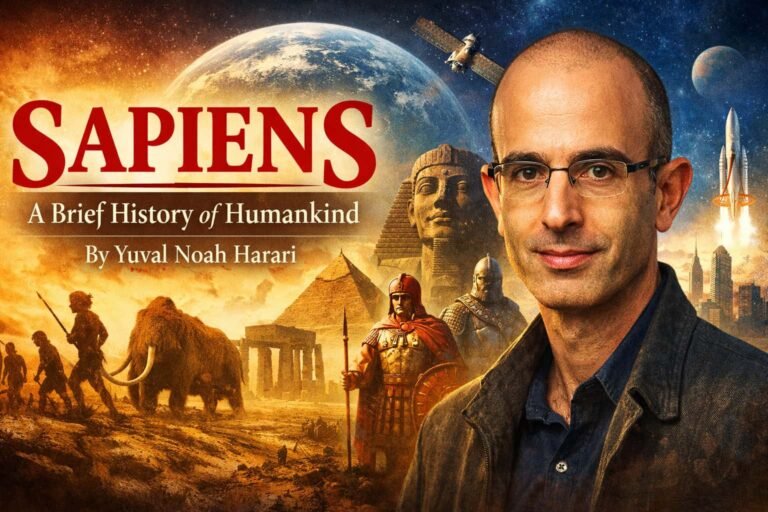
Sapiens is a sweeping, thought-provoking exploration of the history of humankind, tracing how an unremarkable African ape became the dominant force on Earth. In Sapiens: A Brief History of Humankind, Yuval Noah Harari challenges conventional historical narratives and invites readers to rethink everything they know about progress, happiness, power, and meaning. Blending history, biology, anthropology, and philosophy, Sapiens offers a big-picture understanding of how humans shaped the world—and how the world, in turn, shaped us.
- Introduction
- Brief Overview of Sapiens
- Why Sapiens Matters
- About Yuval Noah Harari
- Historical and Cultural Context
- Part One: The Cognitive Revolution (c. 70,000–30,000 years ago)
- Part Two: The Agricultural Revolution (c. 10,000 years ago)
- Part Three: The Unification of Humankind
- Part Four: The Scientific Revolution (c. 1500 CE–Present)
- Main Themes and Ideas in Sapiens
- Key Concepts in Sapiens
- Why Sapiens Is Still Relevant Today
- Conclusion
- FAQ
This comprehensive summary of Sapiens is designed for readers seeking a deep, clear, and engaging understanding of the book’s ideas, themes, and lasting relevance.
Brief Overview of Sapiens
Sapiens tells the story of Homo sapiens from roughly 70,000 years ago to the present—and even into the future. Rather than focusing on kings, wars, or dates, Harari centers the narrative on revolutions in human thinking and organization.
The book is structured around four major revolutions:
- The Cognitive Revolution – How imagination and shared myths made large-scale cooperation possible
- The Agricultural Revolution – How farming reshaped society, often at great cost
- The Unification of Humankind – How money, empires, and religion unified diverse cultures
- The Scientific Revolution – How modern science and capitalism transformed humanity’s power and self-understanding
Important Ideas
- Humans dominate the planet because they cooperate flexibly in large numbers.
- Civilization advanced faster than human happiness.
- Power often matters more than truth in shaping history.
- The future of humanity may involve transcending biological limits.
Throughout Sapiens, Harari asks a provocative question: Did all this progress actually make us happier?
Why Sapiens Matters
Sapiens matters because it reframes human history in a way that feels both unsettling and liberating. It challenges deeply held assumptions—that civilization equals progress, that humans are uniquely moral, and that history naturally bends toward happiness.
For readers searching online for Sapiens, the intent is often clear: they want not just a summary, but understanding. This book helps readers see how stories, beliefs, and systems—many of them fictional—continue to govern modern life, from money and nations to human rights and corporations.
About Yuval Noah Harari
Yuval Noah Harari is an Israeli historian and professor at the Hebrew University of Jerusalem. Trained as a medieval military historian, Harari brings an unusual breadth of perspective to Sapiens, drawing from evolutionary biology, cognitive science, economics, and philosophy.
Harari is known for his ability to synthesize vast amounts of information into clear, compelling narratives. His broader body of work—including Homo Deus and 21 Lessons for the 21st Century—continues the exploration of humanity’s past, future, and ethical challenges.
In Sapiens, Harari’s background allows him to zoom out from narrow historical detail and focus instead on long-term patterns and forces shaping human existence.
Historical and Cultural Context
Sapiens was first published in Hebrew in 2011 and later released internationally, quickly becoming a global bestseller. The book emerged during a period of rapid globalization, technological acceleration, and growing anxiety about humanity’s future.
Several influences shape Sapiens:
- Advances in evolutionary biology and genetics
- Growing skepticism about traditional political and religious narratives
- Concerns over environmental collapse and technological ethics
- A globalized world questioning national and cultural boundaries
Harari wrote Sapiens at a moment when humanity’s power had never been greater—and its sense of direction never more uncertain.
Part One: The Cognitive Revolution (c. 70,000–30,000 years ago)
Before the Cognitive Revolution: Humans as Just Another Animal
For most of their existence, Homo sapiens were not exceptional. They lived in small groups, competed with predators, and shared the planet with other human species such as Neanderthals, Denisovans, and Homo erectus. Like other animals, early humans were constrained by biology: limited communication, small social groups, and local knowledge.
Harari emphasizes that biology alone did not make sapiens dominant. Other animals were stronger, faster, or better adapted to specific environments. Even other human species had larger brains or superior physical traits. The early sapiens’ world was dangerous and uncertain, and there was no indication they would eventually rule the planet.
The Cognitive Leap
Around 70,000 years ago, a mysterious transformation occurred. Harari calls this the Cognitive Revolution, though he acknowledges that we don’t know exactly what triggered it. Genetic mutation, neurological rewiring, or social pressure may all have played roles.
What changed was not intelligence in a narrow sense, but the ability to imagine and communicate complex ideas.
Humans began to:
- Tell stories about things that did not physically exist
- Share abstract concepts like spirits, ancestors, and tribal identities
- Create flexible social bonds beyond kinship
This revolution allowed humans to cooperate in groups far larger than those of any other animal.
Language as a Tool for Cooperation
Animal communication conveys immediate realities: danger, food, or emotions. Human language, however, evolved to convey fiction.
Harari argues that gossip—talking about others—was crucial. Knowing who could be trusted allowed groups to grow beyond close relatives. Over time, these stories expanded into shared myths that defined entire communities.
This is the central argument of Sapiens:
Large-scale human cooperation is based on shared belief, not objective reality.
Imagined Realities and Tribal Identity
Once humans could believe in shared myths, they could organize around:
- Totems
- Gods
- Ancestral spirits
- Group identities
These imagined realities allowed thousands—or eventually millions—of strangers to cooperate. A modern nation-state works the same way as an ancient tribe, just on a larger scale.
Ecological Consequences
As sapiens spread out of Africa, they caused waves of ecological destruction. Large animals disappeared shortly after humans arrived in new regions, suggesting that human expansion triggered mass extinctions.
Harari reframes humanity’s success as morally ambiguous. From the perspective of other species, sapiens were not heroes but a devastating invasive force.
Part Two: The Agricultural Revolution (c. 10,000 years ago)
The Illusion of Progress
The transition from hunting and gathering to agriculture is often described as humanity’s greatest achievement. Harari challenges this narrative sharply.
Hunter-gatherers generally:
- Worked fewer hours
- Ate more diverse diets
- Experienced fewer epidemics
- Had more leisure time
Agriculture increased food supply but worsened individual quality of life. People worked harder, ate less varied food, and became vulnerable to droughts, pests, and disease.
Why Humans Chose Farming Anyway
Harari explains that agriculture was not a single conscious decision. Small changes—planting seeds, staying longer in one place—gradually locked humans into farming lifestyles.
Once populations grew, returning to foraging became impossible. Agriculture created a trap: more food led to more people, which required even more food.
Wheat as the Real Winner
One of Harari’s most memorable arguments is that wheat domesticated humans, not the other way around. Humans rearranged their lives, bodies, and societies to serve the needs of crops.
Fields demanded:
- Permanent settlement
- Hard physical labor
- Protection from animals and other humans
Humans became servants to agricultural cycles.
The Rise of Inequality
Agriculture produced surplus food, enabling:
- Private property
- Inherited wealth
- Social classes
- Political elites
Over time, inequality became normalized and justified through myths: divine right, natural hierarchies, or cosmic order.
Harari stresses that inequality is not biologically inevitable, but socially constructed and maintained through belief.
Imagined Orders and Social Control
To keep agricultural societies stable, humans created systems of rules and hierarchies that existed only in shared imagination—laws, castes, gender roles.
These imagined orders were powerful because people internalized them, enforcing the system themselves.
Part Three: The Unification of Humankind
From Diversity to Unity
Early human cultures were incredibly diverse. Over time, however, history moved toward unification. Harari argues this was not planned but emerged through economic, political, and religious forces.
Despite wars and resistance, humanity gradually formed larger shared systems.
Money: Trust Made Universal
Money is one of the most important inventions in Sapiens. It works because it is pure belief.
Unlike food or tools, money has no intrinsic value. Its power lies in universal trust. Everyone believes everyone else believes in it.
Money:
- Enables cooperation between strangers
- Transcends culture and language
- Converts diverse values into a single system
Empires as Cultural Engines
Empires ruled vast populations and territories, often brutally. Harari does not excuse their violence, but he complicates the narrative.
Empires spread:
- Languages
- Legal systems
- Technologies
- Cultural norms
Modern ideas of citizenship, law, and governance are often imperial legacies.
Religion and Moral Order
Universal religions offered shared moral frameworks across large populations. Harari treats religion functionally rather than theologically.
Religions:
- Justified social order
- Reduced conflict within groups
- Provided meaning and purpose
He also argues that modern ideologies—like nationalism and human rights—function similarly to religions.
Part Four: The Scientific Revolution (c. 1500 CE–Present)
The Discovery of Ignorance
The Scientific Revolution began when humans admitted ignorance. Instead of assuming all answers were known, thinkers began asking questions and testing ideas.
This shift fueled unprecedented growth in knowledge and power.
Science, Capitalism, and Empire
Scientific research required funding. Capitalism provided it by investing in future returns. Empires supported science to gain military and economic advantage.
These three forces reinforced each other, creating the modern world.
The Capitalist Faith
Capitalism depends on trust in continuous growth. Credit allows people to invest based on future expectations.
Harari notes that this system has produced immense wealth—but also inequality, exploitation, and environmental damage.
The Myth of Human Happiness
Despite progress, happiness has not clearly increased. Harari explores psychological research suggesting happiness depends more on expectations and brain chemistry than material conditions.
The End of Homo sapiens
In the final chapters, Sapiens looks forward. Humans are now redesigning life itself through genetic engineering, AI, and biotechnology.
Harari raises profound questions:
- Will humans remain human?
- Who controls these technologies?
- What ethical frameworks will guide the future?
The book ends deliberately unsettled.
Main Themes and Ideas in Sapiens
The Power of Stories
At its core, Sapiens argues that shared stories shape reality. Nations, money, laws, and even human rights exist because people believe in them collectively.
Progress vs. Happiness
Harari repeatedly questions whether historical progress improves individual well-being. Technological advancement often brings new forms of stress and inequality.
Biology and Culture
Human behavior is shaped by both evolutionary biology and cultural invention. Sapiens refuses to reduce humanity to either nature or nurture alone.
Ethics Without Illusions
Rather than offering moral comfort, Sapiens forces readers to confront uncomfortable truths about power, exploitation, and responsibility.
Key Concepts in Sapiens
- Cognitive Revolution – The emergence of imagination and shared myths
- Imagined Order – Social systems that exist through belief
- Intersubjective Reality – Truths shared by groups, not individuals or nature
- Scientific Ignorance – Progress driven by admitting what we don’t know
These ideas form the intellectual backbone of Sapiens.
Interpretation and Analysis
Sapiens is ultimately a mirror. It reflects humanity’s achievements and failures without offering easy moral judgments. Some readers interpret the book as pessimistic; others see it as liberating.
Harari does not argue that life is meaningless—but that meaning is something humans create, not discover.
Why Sapiens Is Still Relevant Today
In an era of AI, climate crisis, and global uncertainty, Sapiens feels more relevant than ever. Its exploration of belief systems, power, and responsibility helps readers understand modern challenges.
The questions Sapiens raises—about identity, progress, and the future—remain unresolved, making the book enduringly powerful.
Sapiens was widely praised for its ambition and clarity, though some scholars criticized its generalizations. Despite debate, it became a defining work of popular intellectual history.
The book reshaped public conversations about history, technology, and ethics. It influenced leaders, educators, and entrepreneurs worldwide.
Conclusion
Sapiens is not just a history of humankind—it is a history of ideas, beliefs, and consequences. By tracing how shared myths shaped the world, Yuval Noah Harari challenges readers to think critically about the present and responsibly about the future.
For anyone seeking a deeper understanding of humanity’s past and possible futures, Sapiens remains essential reading.
FAQ
What is Sapiens about?
Sapiens explores the history of humankind from early evolution to the modern age, focusing on ideas, beliefs, and systems that shaped human societies.
Is Sapiens hard to read?
No. Despite its big ideas, Sapiens is written in clear, engaging language accessible to general readers.
What is the main message of Sapiens?
The book argues that shared myths and imagined realities enabled human cooperation and dominance, but progress does not guarantee happiness.
Is Sapiens scientifically accurate?
While broadly grounded in scholarship, Sapiens simplifies complex debates and is best read as an interpretive synthesis rather than a textbook.
Why should I read Sapiens today?
Sapiens helps readers understand modern issues like technology, inequality, and identity by revealing the historical forces behind them.