
Introduction
The question of the origin of humans is one of the most fundamental questions humans have ever asked. Where do we come from? How did our species arise? And what does our past tell us about who we are today? These questions sit at the crossroads of science, history, and philosophy, shaping how we understand our place in the natural world.
- Introduction
- Early Ideas About Human Origins (Historical Perspective)
- Evolution and Natural Selection Explained Simply
- The Primate Family Tree
- The Earliest Hominins
- Australopithecus and Early Upright Walking
- The Emergence of the Genus Homo
- Homo habilis, Homo erectus, and Early Tool Use
- Fire, Migration, and Early Cultures
- Neanderthals, Denisovans, and Other Human Relatives
- The Rise of Homo sapiens
- Genetic Evidence and Interbreeding
- Human Migration Out of Africa
- The Development of Language, Art, and Society
- What Makes Humans Unique
- Conclusion: Humanity’s Place in Nature
For most of history, explanations for human origins were based on mythology, religion, or speculation. While these stories offered meaning and identity, they were not based on physical evidence. Over the past two centuries, however, scientific research has transformed our understanding of where humans come from. Fossils buried in ancient sediments, genetic information preserved in DNA, and tools left behind by early humans now provide a detailed and testable account of human evolution.
This article explores the origin of humans using evidence from evolutionary biology, paleoanthropology, genetics, and archaeology. It is written for general readers with no scientific background, focusing on clarity, accuracy, and storytelling. By the end, you will see that the story of human origins is not only scientifically fascinating but also deeply human—a story of survival, adaptation, creativity, and connection.
Early Ideas About Human Origins (Historical Perspective)
Long before science offered evidence-based explanations, humans sought answers about their origins through tradition, religion, and philosophy. Nearly every culture developed stories explaining how humans were created and why they exist.
Ancient and Medieval Views
In many ancient societies, humans were believed to be created directly by gods or supernatural forces. These stories often placed humanity at the center of the universe, separate from animals and nature. In ancient Greece, philosophers such as Aristotle attempted to classify living things, arranging them in a hierarchy known as the “great chain of being,” with humans near the top.
While influential, these ideas assumed that species were fixed and unchanging. There was no concept of extinction, deep time, or gradual biological change.
The Birth of Scientific Thinking
The scientific shift began in the 18th and 19th centuries as naturalists studied fossils, geology, and living organisms. Scientists realized that Earth was far older than previously believed and that many species had gone extinct. This set the stage for a revolutionary idea.
In 1859, Charles Darwin published On the Origin of Species, introducing the theory of evolution by natural selection. Darwin later applied this idea to humans, proposing that humans and apes share common ancestors. Although controversial at the time, his ideas were supported by growing evidence and laid the foundation for modern explanations of the origin of human species.
Evolution and Natural Selection Explained Simply
To understand the origin of humans, it is essential to understand evolution.
What Is Evolution?
Evolution is the process by which populations of living organisms change over many generations. These changes occur because individuals vary, and some variations help organisms survive and reproduce more effectively in their environment.
Evolution does not happen to individuals—it happens to populations over long periods of time.
Natural Selection in Everyday Language
Natural selection works through three simple principles:
- Variation: Individuals within a species are not identical.
- Inheritance: Some traits can be passed from parents to offspring.
- Selection: Traits that improve survival or reproduction tend to become more common.
A helpful analogy is a filter. Over time, the environment “filters out” traits that are less helpful, while allowing beneficial traits to spread.
Evolution Is Not a Straight Line
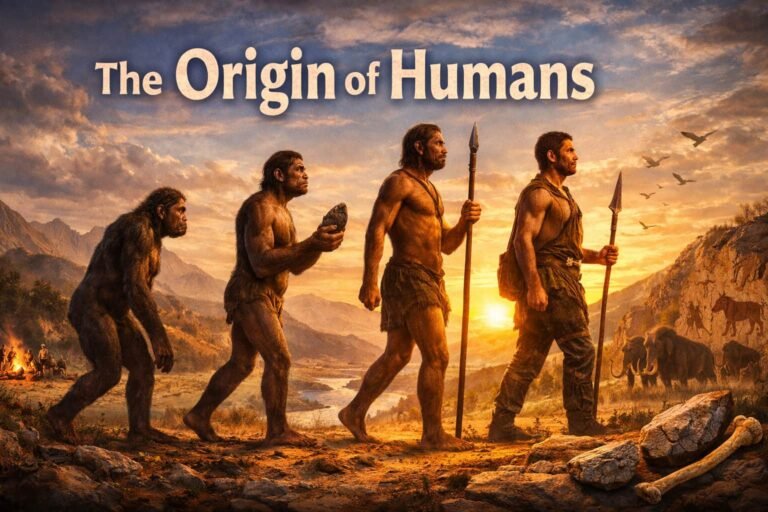
A common misunderstanding is that evolution is a ladder with humans at the top. In reality, evolution is more like a branching tree. Many species evolve from common ancestors, and most branches eventually end in extinction. Humans are not the goal of evolution—we are one successful outcome among many.
The Primate Family Tree
Humans are part of the primate family, a group of mammals that includes monkeys, apes, and lemurs.
Shared Primate Traits
Primates share several important characteristics:
- Forward-facing eyes that allow depth perception
- Grasping hands with opposable thumbs
- Relatively large brains
- Complex social behaviors
These traits evolved primarily for life in trees and social cooperation.
Humans and Other Apes
Humans are most closely related to chimpanzees and bonobos, followed by gorillas and orangutans. Genetic evidence shows that humans and chimpanzees share about 98–99% of their DNA. This means we share a recent common ancestor that lived around 6 to 7 million years ago.
Importantly, humans did not evolve from modern apes. Instead, humans and apes evolved separately from a shared ancestral population.
The Earliest Hominins
The term hominin refers to humans and our closest extinct relatives after the evolutionary split from chimpanzees.
Early Human Ancestors
Some of the earliest known hominins include:
- Sahelanthropus tchadensis (about 7 million years old)
- Orrorin tugenensis (about 6 million years old)
- Ardipithecus ramidus (about 4.4 million years old)
These fossils show a mix of ape-like and human-like traits, suggesting a gradual transition rather than a sudden change.
The Importance of Walking Upright
One of the defining traits of hominins is bipedalism, or walking on two legs. Fossil evidence shows that upright walking evolved before large brains.
Walking upright had major advantages:
- Hands were freed for carrying objects and using tools
- Long-distance travel became more efficient
- New ways of interacting with the environment became possible
Australopithecus and Early Upright Walking
The genus Australopithecus is one of the most important groups in the story of the origin of humans.
Lucy and Her Kind
In 1974, scientists discovered a partial skeleton in Ethiopia known as “Lucy,” belonging to Australopithecus afarensis. Lucy lived about 3.2 million years ago and clearly walked upright, even though her brain was relatively small.
Life as an Australopithecine
Australopithecines:
- Walked upright but could still climb trees
- Lived in Africa
- Ate a varied diet of plants and some meat
- Likely lived in social groups
They were not humans, but they were no longer simply apes.
The Emergence of the Genus Homo
Around 2.5 million years ago, a major evolutionary shift occurred with the appearance of the genus Homo.
Key Changes
Compared to earlier hominins, members of Homo had:
- Larger brains
- Smaller teeth and jaws
- Greater reliance on tools
- More flexible diets
These changes mark a crucial stage in the origin of human species.
Homo habilis, Homo erectus, and Early Tool Use
Homo habilis: The First Toolmakers
Homo habilis lived between 2.4 and 1.4 million years ago and is associated with the earliest known stone tools. These tools were simple but effective, used to cut meat and process plants.
Homo erectus: A Global Species
Homo erectus appeared around 1.9 million years ago and showed many modern human traits, including a larger brain and body proportions suited for long-distance walking.
This species was the first human ancestor to leave Africa, spreading into Asia and Europe.
Fire, Migration, and Early Cultures
The control of fire was one of the most transformative developments in human evolution.
Why Fire Was Revolutionary
Fire allowed early humans to:
- Cook food, increasing its nutritional value
- Stay warm in colder climates
- Protect themselves from predators
- Gather socially around a shared resource
Cultural Adaptation
As humans migrated into new environments, they developed new tools, shelters, and behaviors. Culture became a powerful survival strategy, allowing humans to adapt faster than biological evolution alone.
Neanderthals, Denisovans, and Other Human Relatives
For much of human history, multiple human species lived at the same time.
Neanderthals
Neanderthals lived in Europe and western Asia until about 40,000 years ago. They were skilled hunters, toolmakers, and likely used language. Evidence shows they cared for the injured and buried their dead.
Denisovans
Denisovans are known mainly from genetic evidence. They lived in Asia and interbred with modern humans, contributing DNA to populations in Oceania and parts of Asia.
The Rise of Homo sapiens
Homo sapiens, our own species, appeared in Africa around 300,000 years ago.
What Made Us Different
Early modern humans developed:
- Highly complex language
- Symbolic thinking
- Advanced tools
- Art, music, and ritual practices
These abilities allowed Homo sapiens to spread across the globe and eventually replace other human species.
Genetic Evidence and Interbreeding
DNA has become one of the most powerful tools for understanding the origin of humans.
What Genetics Reveals
Genetic studies show that:
- All modern humans share a common African origin
- Non-African populations carry Neanderthal DNA
- Some populations also carry Denisovan DNA
This evidence shows that human evolution involved interbreeding, not strict separation.
Human Migration Out of Africa
The strongest scientific evidence supports the “Out of Africa” model.
Global Expansion
Modern humans began leaving Africa around 60,000–70,000 years ago, eventually reaching:
- Australia by about 50,000 years ago
- Europe by about 45,000 years ago
- The Americas by at least 15,000 years ago
Migration shaped both genetic diversity and cultural traditions.
The Development of Language, Art, and Society
Culture became humanity’s most powerful tool.
Language
Language allowed humans to share knowledge, coordinate large groups, and pass information across generations.
Art and Symbolism
Cave paintings, carvings, and musical instruments show that early humans thought symbolically and creatively, laying the foundation for religion, science, and philosophy.
What Makes Humans Unique
Humans are not unique because we evolved, but because of how evolution shaped us.
Distinctive human traits include:
- Complex language
- Cumulative culture
- Advanced cooperation
- Moral and ethical reasoning
These traits allowed humans to reshape environments and societies on an unprecedented scale.
Conclusion: Humanity’s Place in Nature
The origin of humans is not a story of sudden creation or linear progress. It is a long, complex history shaped by evolution, adaptation, cooperation, and creativity. Humans are part of nature, not separate from it.
By understanding where humans come from, we gain a deeper appreciation of our shared past and a clearer sense of responsibility for our shared future.
Ongoing Discoveries and Unanswered Questions
The story of human origins is still being written. New fossil discoveries and genetic techniques continue to challenge old assumptions and raise new questions.
Scientists are still exploring:
- How many human species existed
- Why some species went extinct
- How biology and culture interacted over time