

Introduction
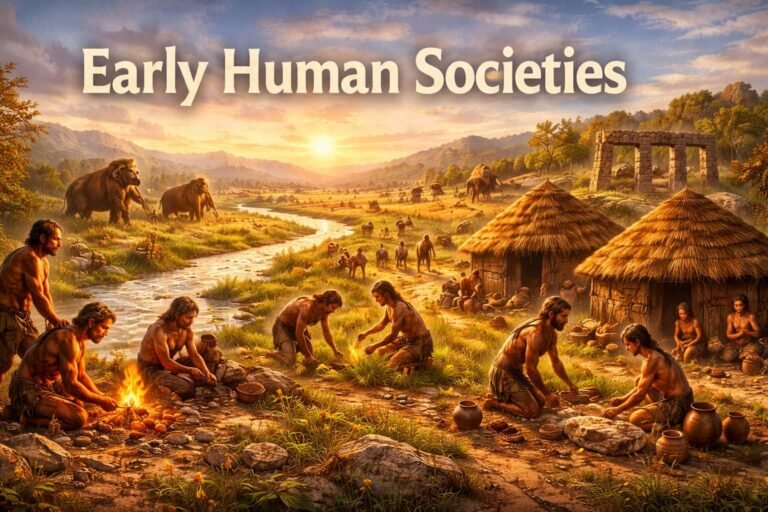
Understanding early human societies is essential for understanding the entire course of human history. Long before writing, cities, or states existed, humans lived in small groups that developed ways of surviving, cooperating, and making sense of the world. These early societies laid the biological, cultural, and social foundations for everything that followed, from ancient civilizations to the modern globalized world.
- Introduction
- Peopling the Earth
- The Development of Language, Art, and Society
- Paleolithic Societies and Their Organization
- Paleolithic Technologies, Cultures, and Art
- The Neolithic Revolution and the Birth of Agriculture
- Social, Political, and Environmental Changes in Early Civilizations
- Conclusion: From Early Societies to Human History
Early human societies bridge the gap between human origins and early civilizations. They show how humans moved from small bands of hunter-gatherers to settled communities, how culture became as important as biology, and how humans learned to reshape environments rather than simply adapt to them. Studying these societies helps explain why humans are so diverse, cooperative, and technologically creative.
This article explores early human societies using evidence from archaeology, anthropology, history, and environmental studies. It traces humanity’s journey as people spread across the planet, developed Paleolithic cultures, created art and technology, and eventually transformed their way of life through the Neolithic Revolution. The story is not one of simple progress, but of adaptation, experimentation, and trade-offs that continue to shape human life today.
Peopling the Earth
One of the most significant chapters in early human societies is the peopling of the Earth—the process by which humans spread from their African homeland to every major continent except Antarctica.
Human Migration Out of Africa
Scientific evidence strongly supports the conclusion that modern humans (Homo sapiens) originated in Africa around 300,000 years ago. Fossils from sites such as Jebel Irhoud in Morocco and Omo Kibish in Ethiopia show early modern human features. Genetic studies further demonstrate that African populations contain the greatest human genetic diversity, indicating a long history there.
Beginning around 60,000–70,000 years ago, some human groups began migrating out of Africa. These migrations did not occur as a single event but as multiple waves over thousands of years.
Routes Into Eurasia, Australia, and the Americas
As humans spread, they followed coastlines, river valleys, and grasslands:
- Eurasia: Humans moved into the Middle East, Europe, and Asia, encountering and interbreeding with Neanderthals and Denisovans.
- Australia: Humans reached Australia by at least 50,000 years ago, likely using simple watercraft to cross open seas.
- The Americas: The Americas were populated much later, probably by groups crossing from Siberia via Beringia during the last Ice Age, with evidence dating to at least 15,000 years ago.
Environmental Challenges and Adaptation
As humans entered new environments—deserts, ice-age tundra, rainforests—they adapted through technology and culture rather than rapid biological change. Clothing, shelter, fire, and social cooperation allowed humans to thrive in conditions that would otherwise be lethal.
Archaeological and Genetic Evidence
Archaeological sites containing stone tools, hearths, and campsites trace these migrations, while genetic markers preserved in DNA confirm patterns of movement and interbreeding. Together, archaeology and genetics provide a powerful, evidence-based picture of how early human societies spread across the globe.
The Development of Language, Art, and Society
One of the most remarkable chapters in the human history is the emergence of language, art, and complex societies. These developments did not appear suddenly, nor were they inevitable. Instead, they evolved gradually through a close interaction between biology, environment, and culture. Together, language, art, and social organization transformed Homo sapiens from a clever primate into a species capable of building civilizations.
The Evolution of Language
Language is perhaps the single most powerful adaptation in human evolution. It allowed humans to share information, coordinate actions, and transmit knowledge across generations in ways no other species can match.
From Sounds to Symbols
Early hominins likely communicated using a combination of gestures, facial expressions, and simple vocalizations, similar to modern apes. Over time, several biological and cognitive changes made more complex speech possible:
- Brain expansion, especially in regions associated with language processing
- Changes in the vocal tract, including the position of the larynx
- Improved breath control, allowing sustained speech sounds
These changes did not create language by themselves, but they made it possible.
Language likely evolved gradually, beginning with simple sounds that conveyed immediate meanings such as danger, food, or social signals. Over tens of thousands of years, these sounds became structured into words, grammar, and symbolic communication.
Why Language Was a Survival Advantage
Language dramatically increased survival and reproductive success. It allowed early humans to:
- Coordinate hunting and gathering activities
- Warn others of predators or environmental dangers
- Teach tool-making techniques and survival skills
- Strengthen social bonds through storytelling and shared identity
A useful analogy is to think of language as a “social technology.” Just as tools extended physical abilities, language extended mental and social abilities.
Language and Thought
Language also reshaped human thinking. By attaching symbols to ideas, humans could think abstractly, plan for the future, and reflect on the past. This capacity for symbolic thought is a cornerstone of modern human cognition and plays a key role in human evolution.
The Rise of Art and Symbolic Expression
Art is one of the clearest signs that humans were thinking symbolically rather than reacting purely to immediate needs.
Early Evidence of Art
The archaeological record reveals that symbolic behavior emerged tens of thousands of years ago:
- Cave paintings in Europe, Africa, and Indonesia
- Carved figurines representing animals and humans
- Body ornaments, such as beads and ochre pigments
Some of the oldest known cave art dates back more than 40,000 years, suggesting that artistic expression appeared early in the history of Homo sapiens.
What Art Meant to Early Humans
Art was not decoration for decoration’s sake. It likely served important social and psychological functions:
- Expressing group identity and shared beliefs
- Communicating stories, myths, and knowledge
- Strengthening social cohesion
- Possibly playing a role in rituals and spirituality
Creating art required time, planning, and cooperation, indicating that early humans lived in relatively stable social groups.
Symbolism and Meaning
Symbolic thinking—the ability to let one thing stand for another—is a defining feature of human cognition. Art shows that early humans could assign meaning beyond immediate physical reality, a capacity that underlies religion, science, and culture.
The Growth of Complex Social Structures
As language and symbolic thinking developed, human societies became more complex.
From Small Groups to Cooperative Communities
Early humans likely lived in small bands of hunter-gatherers, usually consisting of extended families. Over time, these groups became more interconnected through:
- Shared language and customs
- Trade and exchange networks
- Intermarriage between groups
Language made it possible to maintain social relationships beyond immediate kin, greatly expanding group size and cooperation.
Social Rules and Moral Behavior
Living in larger groups required new ways of managing conflict and cooperation. Early societies developed informal rules governing:
- Sharing food
- Caring for the young and elderly
- Resolving disputes
- Punishing harmful behavior
These early moral systems helped stabilize groups and increased survival chances.
Cooperation as a Human Strength
Humans are uniquely cooperative. Unlike most animals, humans regularly cooperate with non-relatives. This ability was supported by:
- Communication and shared goals
- Emotional bonds and empathy
- Cultural norms and traditions
Cooperation allowed humans to hunt large animals, defend territories, and adapt to challenging environments.
Culture as an Evolutionary Force
Culture became a second inheritance system alongside genetics.
Cumulative Culture
One of the most important aspects of human society is cumulative culture—the ability to build upon previous knowledge rather than starting from scratch each generation.
For example:
- Tool designs improved over time
- Knowledge about plants and animals accumulated
- Social traditions became more complex
This process allowed human societies to adapt rapidly without waiting for biological evolution.
Teaching and Learning
Humans actively teach their young, passing on skills, values, and beliefs. This intensive learning period is unique among animals and played a major role in shaping human societies.
Language, Art, and Society Working Together
Language, art, and social structure did not evolve independently. They reinforced one another:
- Language enabled storytelling and tradition
- Art strengthened shared identity and belief systems
- Social organization supported cooperation and innovation
Together, these developments transformed Homo sapiens into a highly adaptable and creative species.
Paleolithic Societies and Their Organization
For more than 90 percent of human history, people lived in Paleolithic societies, also known as hunter-gatherer societies. These societies were small, mobile, and highly adaptable.
Hunter-Gatherer Lifeways
Paleolithic societies survived by hunting animals, fishing, and gathering wild plants. Their diets were diverse and changed with the seasons. Rather than exhausting resources, many groups moved regularly to allow environments to recover.
Hunter-gatherers were not constantly struggling to survive. Evidence from modern and ancient hunter-gatherers suggests that many had adequate nutrition and leisure time compared to early farmers.
Social Structure and Cooperation
Paleolithic groups typically consisted of 20 to 50 individuals, often linked by kinship and marriage. Cooperation was essential:
- Food was often shared
- Knowledge about landscapes was passed orally
- Group decisions were made collectively
Leadership was usually informal and based on experience rather than power.
Gender Roles and Division of Labor
Archaeological evidence shows that labor was divided, but not rigidly. While hunting large game often involved men, women played critical roles in gathering plant foods, which provided a large portion of calories. There is also evidence that women hunted and men gathered in some societies, challenging modern stereotypes.
Mobility and Seasonal Movement
Mobility was a defining feature of Paleolithic societies. Groups moved according to seasonal availability of food and water, shaping flexible social structures and strong knowledge of local environments.
Paleolithic Technologies, Cultures, and Art
Technology and culture were central to early human societies, even long before agriculture or cities.
Stone Tool Industries and Innovation
Stone tools define much of the Paleolithic archaeological record. Over time, tools became more specialized and refined:
- Early tools were simple cutting stones
- Later tools included blades, scrapers, and projectile points
- Technologies varied by region and culture
Tool-making skills were learned and passed down, forming early traditions.
Fire, Clothing, and Shelters
The controlled use of fire transformed human life. Fire provided warmth, protection, cooked food, and social gathering spaces. Evidence of fire use dates back at least 400,000 years.
Clothing made from animal skins and shelters built from wood, bone, and stone allowed humans to survive in cold climates, especially during Ice Age periods.
Symbolic Behavior and Art
Paleolithic art represents a major cognitive shift. Cave paintings in places such as Lascaux (France) and Altamira (Spain), along with figurines and engraved objects, show symbolic thinking.
Art likely served multiple purposes:
- Strengthening group identity
- Communicating stories and beliefs
- Playing roles in ritual and spirituality
Cultural Diversity Among Paleolithic Groups
There was no single Paleolithic culture. Groups developed distinct traditions, technologies, and artistic styles, reflecting local environments and histories. Early human cultures were diverse, dynamic, and creative.
The Neolithic Revolution and the Birth of Agriculture
Around 12,000 years ago, some human societies underwent one of the most profound changes in history: the Neolithic Revolution.
What Was the Neolithic Revolution?
The Neolithic Revolution refers to the transition from hunting and gathering to farming and herding. This change occurred independently in multiple regions rather than spreading from a single origin.
Independent Origins of Agriculture
Agriculture emerged in several parts of the world, including:
- The Fertile Crescent (wheat, barley)
- China (rice, millet)
- Mesoamerica (maize)
- The Andes (potatoes)
- Africa (sorghum, millet)
This shows that farming was a response to local conditions, not a universal improvement.
Domestication of Plants and Animals
Domestication involved selective breeding of plants and animals to favor traits useful to humans, such as larger seeds or calmer behavior. Over generations, domesticated species became biologically distinct from their wild ancestors.
Benefits and Costs of Farming
Agriculture allowed food surpluses, population growth, and permanent settlements. However, it also brought costs:
- Less varied diets
- Increased disease
- Greater social inequality
- Environmental degradation
Farming was not automatically better than hunting and gathering—it was a trade-off.
Changes in Diet, Health, and Population
Early farmers often suffered poorer health than hunter-gatherers, but higher birth rates led to population growth. This demographic pressure helped spread farming despite its disadvantages.
Social, Political, and Environmental Changes in Early Civilizations
As agriculture spread, some societies grew larger and more complex, leading to the first early civilizations.
Permanent Settlements and Urbanization
Farming encouraged permanent villages, which sometimes grew into towns and cities. These settlements required new ways of organizing space, resources, and people.
Social Hierarchy and Labor Specialization
Surplus food allowed some individuals to specialize as artisans, traders, priests, or leaders. Over time, social stratification emerged, with differences in wealth and power becoming more pronounced.
Early Political Organization
Early political systems developed to manage irrigation, trade, defense, and conflict. Leadership ranged from councils to hereditary rulers, depending on the society.
Environmental Impact
Early civilizations reshaped landscapes through deforestation, irrigation, and agriculture. While these changes supported population growth, they also caused soil depletion, flooding, and long-term environmental challenges—issues still relevant today.
Conclusion: From Early Societies to Human History
Early human societies laid the foundation for all later history. Through migration, cooperation, technological innovation, and cultural creativity, humans transformed from small groups of foragers into complex societies capable of building civilizations.
The long-term consequences of agriculture and civilization include population growth, inequality, technological advancement, and environmental change. These developments brought both opportunities and challenges, shaping the world we inherited.
By studying early human societies, we gain insight into humanity’s shared past and a deeper understanding of how cultural choices continue to shape our future. The story of early human societies is ultimately a story of adaptation, resilience, and creativity—qualities that remain central to what it means to be human.