
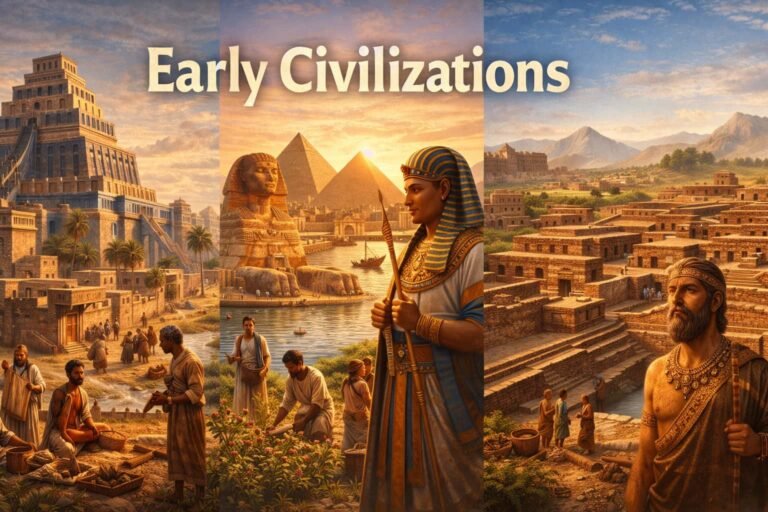
Early civilizations explained through archaeology and history, from Mesopotamia and Egypt to the Indus Valley, Shang China, and ancient American societies.
Introduction
The study of early civilizations seeks to understand how humans moved from small-scale societies to large, complex communities organized around cities, states, and institutions. Civilizations did not emerge suddenly or in the same way everywhere. Instead, they developed gradually as people experimented with new ways of living, governing, and interacting with their environments.
Historians and archaeologists generally use the term civilization to describe societies with dense populations, permanent settlements, organized political authority, social hierarchies, economic specialization, and shared cultural systems such as religion, art, and writing. These features distinguish civilizations from earlier human societies, such as Paleolithic hunter-gatherers or early farming villages, though the boundaries are not always sharp.
Early civilizations matter because they created many of the foundations of the modern world. Systems of government, law, taxation, religion, long-distance trade, and record-keeping all developed within early civilizations. At the same time, these societies faced challenges—environmental stress, inequality, conflict—that remain familiar today. Studying early civilizations helps us understand both the achievements and the costs of complex social organization.
Common Features of Early Civilizations
While early civilizations developed independently in different parts of the world, they share several broad characteristics. These similarities reflect common responses to similar challenges rather than direct contact or imitation.
Permanent Settlements and Cities
One defining feature of early civilizations is the presence of permanent settlements, often growing into cities. Cities served as centers of political authority, religious activity, trade, and craft production. Archaeological evidence shows planned streets, public buildings, and defensive structures, indicating long-term investment in place.
Agriculture and Food Surplus
All early civilizations depended on agriculture. Farming produced food surpluses, meaning more food than was needed for immediate survival. Surpluses allowed populations to grow and supported people who were not directly involved in food production, such as artisans, priests, and administrators.
Social Stratification and Specialization
As societies grew larger, social differences became more pronounced. Archaeological evidence—such as differences in housing, burial goods, and diet—suggests the emergence of social hierarchies. Labor specialization also increased, with individuals focusing on specific crafts, trades, or administrative roles.
Political Organization and Governance
Early civilizations developed systems of governance to manage resources, resolve disputes, and organize labor. Political authority could take many forms, from councils of elders to hereditary kings. Written laws and administrative records helped rulers exert control over large populations.
Writing, Record-Keeping, and Symbolic Systems
Many early civilizations developed writing or symbolic systems for communication and record-keeping. Writing was often used for economic transactions, religious texts, and political administration. Even where full writing systems did not exist, symbolic art and ritual objects played similar cultural roles.
Environmental Management and Challenges
Early civilizations reshaped their environments through irrigation, deforestation, and construction. These interventions increased productivity but also introduced risks, such as soil degradation, flooding, and resource depletion. Environmental management was both a strength and a vulnerability.
Ancient Mesopotamia
Geography and Environment
Ancient Mesopotamia developed in the region between the Tigris and Euphrates rivers, in what is now Iraq and parts of neighboring countries. The rivers provided water for agriculture but were unpredictable, flooding irregularly and sometimes destructively.
Environmental Opportunities and Risks
The fertile soil of Mesopotamia supported early farming, but managing water required complex irrigation systems. Maintaining canals and levees demanded organized labor and cooperation, reinforcing the need for political authority.
Social Structure
Mesopotamian society was socially stratified. At the top were elites, including priests and rulers, followed by merchants, artisans, farmers, and enslaved people. Family life was patriarchal, though women could own property and conduct business in some periods.
Political Organization
Mesopotamia consisted of independent city-states such as Uruk, Ur, and Lagash. Each city-state had its own ruler, often seen as chosen by the gods. Law codes, most famously the Code of Hammurabi, regulated social relations and reinforced social hierarchy.
Economy, Religion, and Culture
Trade connected Mesopotamia to distant regions, bringing in metals, timber, and stone. Temples functioned as religious and economic centers. Writing, known as cuneiform, began as a system for recording transactions and later expanded to literature, law, and science.
Ancient Egypt
Geography and the Nile Environment
Ancient Egypt developed along the Nile River, whose predictable annual flooding deposited fertile silt on surrounding fields. This environmental stability supported consistent agricultural production.
Predictable Flooding and Agricultural Stability
Unlike Mesopotamia’s erratic rivers, the Nile’s regular floods made long-term planning possible. This reliability contributed to Egypt’s political continuity and cultural cohesion.
Social Hierarchy
Egyptian society was hierarchical. At the top was the pharaoh, followed by nobles, priests, scribes, artisans, and farmers. Enslaved people were present but did not form the backbone of the economy.
Political and Religious Systems
The pharaoh was considered both a political ruler and a divine figure. A centralized bureaucracy collected taxes, managed labor, and oversaw construction projects. Religion permeated daily life, with strong beliefs in the afterlife shaping burial practices.
Architecture, Writing, and Culture
Egyptian architecture includes monumental structures such as pyramids and temples. Writing systems—hieroglyphs and hieratic script—were used for religious texts and administration. Art followed strict conventions emphasizing order and continuity.
Ancient India (Indus Valley Civilization)
Geography and Environment
The Indus Valley Civilization developed along the Indus River system, influenced by seasonal monsoon rains. Its environment supported agriculture but was sensitive to climate changes.
Urban Planning and Society
Cities such as Harappa and Mohenjo-daro display remarkable urban planning, with grid layouts, standardized bricks, and advanced drainage systems. This suggests strong social organization and shared planning principles.
Sanitation and Architecture
The Indus cities featured covered drains, wells, and standardized housing, indicating a concern for public hygiene rarely seen in other early civilizations.
Economy and Trade
Agriculture formed the economic base, supplemented by craft production and long-distance trade with Mesopotamia. Artifacts such as seals suggest commercial and symbolic uses.
Political and Cultural Characteristics
Unlike Mesopotamia or Egypt, there is little evidence of kings or monumental palaces. This absence raises questions about political organization, which remains one of the major uncertainties surrounding the Indus Valley civilization.
Shang Dynasty China
Geography and Environment
The Shang dynasty emerged in the Yellow River basin, an area prone to flooding but rich in fertile soil. Managing the river was a major challenge.
Political Structure
Shang society was ruled by kings who controlled territory through warfare and alliances. Power was supported by military force and ritual authority.
Society and Religion
Religion centered on ancestor worship. Oracle bones—animal bones used for divination—provide some of the earliest evidence of Chinese writing and offer insight into political and religious concerns.
Technology and Culture
The Shang are known for advanced bronze metallurgy, producing ritual vessels and weapons. Writing during this period laid the foundation for later Chinese scripts.
Early Civilizations of the Ancient Americas
The Olmec Civilization
The Olmec civilization, often considered the earliest civilization in Mesoamerica, developed along the Gulf Coast of present-day Mexico.
Geography and Monumental Art
The Olmec inhabited a tropical environment and are famous for colossal stone heads, likely representing rulers or elites.
Religion and Symbolism
Olmec art features symbolic motifs that influenced later Mesoamerican cultures, suggesting shared religious ideas.
Andean and Chavín Cultures
In South America, early civilizations developed in challenging environments.
Mountain Environments and Adaptation
The Andes required innovative agricultural techniques, such as terracing, to manage steep terrain and variable climates.
Religious Centers and Influence
The Chavín culture centered around ceremonial sites that served as religious hubs, influencing surrounding regions through shared symbols and rituals.
Social and Political Organization
Leadership in these societies often combined political and religious authority. Environmental management, especially water control, was central to survival.
Social, Political, and Environmental Characteristics Compared
Across regions, early civilizations shared common challenges but responded differently:
- Environment: Rivers supported agriculture but required management.
- Politics: Authority ranged from divine kingship to less centralized systems.
- Society: Social hierarchy emerged everywhere, though its expression varied.
- Environmental Impact: Human modification of landscapes brought both prosperity and vulnerability.
These comparisons show that civilizations were not uniform stages of development but diverse solutions to local conditions.
Conclusion: The Legacy of Early Civilizations
Early civilizations transformed human life. They created cities, states, and cultural traditions that shaped later history across the globe. At the same time, they introduced challenges—inequality, environmental stress, conflict—that remain part of the human story.
The legacy of early civilizations lies not only in their achievements but also in their lessons. By studying how ancient societies balanced cooperation, power, and environmental limits, we gain insight into enduring human challenges. Early civilizations remind us that complexity brings both opportunity and responsibility, a truth as relevant today as it was thousands of years ago.