
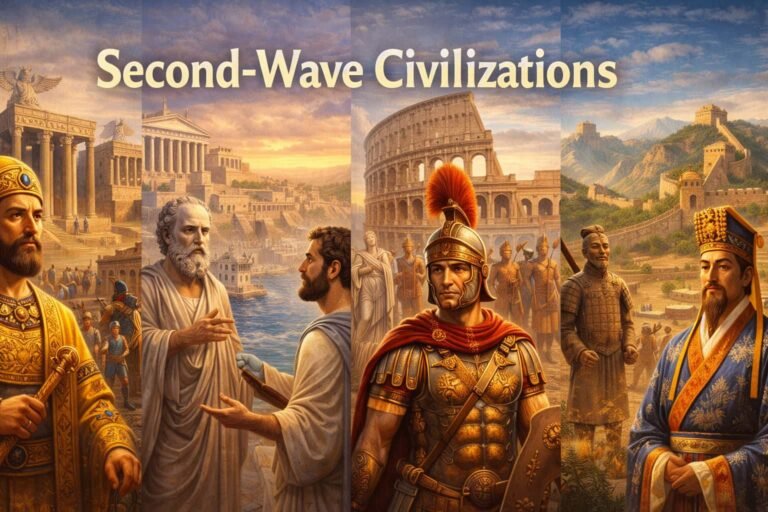
Second-wave civilizations explained, from ancient Persia and classical Greece to Rome, China, India, and the Silk Road, exploring empires, ideas, and global exchange
- Introduction
- The Rise of Empires and New Political Systems
- Ancient Persia and the Achaemenid Empire
- Classical Greece
- The Empire of Alexander the Great
- The Rise of Rome
- Ancient and Imperial China
- Religion and Philosophy in the Second-Wave World
- Early Civilizations of the Americas
- Empires in India
- Women, Families, and Everyday Life
- Transregional Trade and the Silk Road
- Social, Political, and Environmental Patterns Compared
- Conclusion: The Legacy of Second-Wave Civilizations
Introduction
Historians use the term second-wave civilizations to describe a group of societies that emerged after the world’s earliest river-valley civilizations, roughly between 1000 BCE and 600 CE. These civilizations were not simply larger versions of earlier ones. They introduced new political forms, new ways of thinking, and far-reaching connections that reshaped much of the ancient world.
Early civilizations such as Mesopotamia, Egypt, and the Indus Valley were mostly regional. Second-wave civilizations expanded across vast territories, creating empires that ruled over many peoples, languages, and environments. They also produced influential philosophies and religions that addressed ethical behavior, governance, and the meaning of human life.
Second-wave civilizations differ from earlier societies in several key ways:
- They developed large territorial empires rather than city-states alone
- They relied on bureaucracies and professional armies
- They encouraged long-distance trade and cultural exchange
- They generated philosophical and religious traditions that spread widely
Understanding second-wave civilizations helps explain how the ancient world became interconnected and how political ideas, belief systems, and social structures still influential today first took shape.
The Rise of Empires and New Political Systems
Expansion Beyond City-States
Earlier civilizations were often limited to river valleys or clusters of cities. Second-wave civilizations expanded far beyond these boundaries. Through conquest, diplomacy, and colonization, empires brought together diverse regions under a single political authority.
This expansion required new forms of rule. Governing millions of people over thousands of kilometers demanded organization on an unprecedented scale.
Administrative Systems and Governance
Second-wave civilizations developed bureaucracies—systems of officials who collected taxes, enforced laws, and managed resources. Written records, standardized laws, and official languages helped rulers maintain control.
Empires relied less on personal loyalty and more on institutions. This shift made states more stable but also more complex.
Military Organization and Territorial Control
Professional armies replaced temporary citizen militias. Soldiers were trained, equipped, and paid by the state. Roads, fortifications, and supply systems supported long campaigns and distant frontiers.
Environmental and Logistical Challenges
Large empires faced environmental limits. Feeding cities and armies required careful management of agriculture, water, and trade. Environmental mismanagement, droughts, or overextension could weaken even powerful states.
Ancient Persia and the Achaemenid Empire
Ancient Persia and the Achaemenid Empire represent one of the most significant political and cultural achievements of the ancient world. Emerging in the 6th century BCE, the Persian Empire became the first true world empire, stretching across three continents and ruling over tens of millions of people from diverse ethnic, linguistic, and religious backgrounds. Its success lay not only in military conquest but in innovative systems of governance, infrastructure, and ideology that allowed such a vast territory to function as a single political entity.
Geography and Environmental Setting
The Persian homeland lay on the Iranian Plateau, a region characterized by rugged mountains, high plains, deserts, and limited arable land. Unlike the river-based civilizations of Mesopotamia and Egypt, Persia developed in a more environmentally challenging setting. This shaped Persian society in important ways.
The Iranian Plateau encouraged:
- Pastoralism and mixed agriculture
- Mobility and military skill
- Adaptation to water scarcity
Persia’s central location connected Mesopotamia, Central Asia, South Asia, and the eastern Mediterranean. This geographic position later allowed the empire to control major trade routes and facilitate long-distance exchange.
The Rise of the Achaemenid Dynasty
The Achaemenid Empire began as a small Persian kingdom under Median domination. This changed with Cyrus II, later known as Cyrus the Great, who rebelled against Median rule around 550 BCE.
Within a few decades, Cyrus conquered:
- Media
- Lydia (in Anatolia)
- Babylon (539 BCE)
The conquest of Babylon marked a turning point. Instead of destroying the city, Cyrus presented himself as a legitimate ruler, respecting local traditions and religious practices. This approach became a defining feature of Persian imperial rule.
Cyrus the Great and Imperial Ideology
Cyrus the Great is remembered not just as a conqueror but as an empire-builder with a distinct political philosophy. Inscriptions such as the Cyrus Cylinder suggest an ideology centered on justice, stability, and divine favor.
Key elements of Cyrus’s imperial approach included:
- Respect for local religions and customs
- Restoration of temples and cults
- Use of existing administrative structures
- Avoidance of mass deportation or destruction
While modern interpretations should avoid projecting contemporary human rights concepts onto the ancient world, Cyrus’s policies were unusually pragmatic and effective for their time.
Administrative Systems and Governance
Governing the largest empire the world had yet seen required innovation. The Achaemenids developed a sophisticated administrative system that balanced central authority with regional autonomy.
Satrapies
The empire was divided into provinces called satrapies, each governed by a satrap (provincial governor). To prevent rebellion:
- Military commanders, tax collectors, and judges were often separate officials
- Royal inspectors, sometimes called “the eyes and ears of the king,” monitored governors
This system reduced corruption and limited the concentration of power.
Law, Language, and Record-Keeping
Rather than imposing a single legal or linguistic system, the Persians allowed local laws to remain in place. Imperial administration used multiple languages, including:
- Old Persian
- Elamite
- Akkadian
- Aramaic (as a common administrative language)
This flexibility helped maintain stability across diverse populations.
Infrastructure and Communication
Persian rulers invested heavily in infrastructure to unify the empire.
Roads and Communication
The most famous route, the Royal Road, stretched over 2,500 kilometers from Anatolia to Mesopotamia. A relay system of messengers allowed royal orders to travel rapidly.
This system enabled:
- Efficient tax collection
- Military coordination
- Imperial oversight
Water Management and Agriculture
In arid regions, Persians developed qanats, underground irrigation channels that transported water from mountains to fields. These systems increased agricultural productivity and supported urban life in dry environments.
Social Structure and Daily Life
Persian society was hierarchical but flexible. At the top stood the king and royal family, followed by nobles, administrators, soldiers, artisans, merchants, and farmers.
Unlike some other ancient societies:
- Local elites were often integrated into imperial administration
- Social mobility was possible through military or administrative service
- Cultural diversity was accepted rather than suppressed
Women in elite Persian families could own property and manage estates, though evidence is limited and varies by region.
Religion and Zoroastrianism
Religion played a central role in Persian political and moral thought, most notably through Zoroastrianism, one of the world’s oldest known ethical religions.
Origins of Zoroastrianism
Zoroastrianism is associated with the prophet Zarathustra (or Zoroaster), though his exact date remains debated, possibly between 1500 and 1000 BCE. The religion likely developed among pastoral communities in eastern Iran.
Core Beliefs
Zoroastrianism introduced a powerful moral framework centered on choice and responsibility.
Key concepts include:
- Ahura Mazda: the supreme god associated with truth, wisdom, and order
- Asha: cosmic truth and moral order
- Druj: falsehood and chaos
- Free will: humans must choose between good and evil
Rather than ritual alone, Zoroastrianism emphasized ethical behavior, honesty, and justice.
Zoroastrianism and the Persian State
Scholars debate how closely Zoroastrianism functioned as a state religion under the Achaemenids. There is limited direct evidence of standardized religious practice across the empire.
However:
- Royal inscriptions emphasize truth, order, and divine favor
- Kings portrayed themselves as guardians of justice
- Religious tolerance was practiced rather than enforced conversion
This suggests Zoroastrian ideas influenced imperial ideology without being rigidly imposed.
Fire, Ritual, and Worship
Fire symbolized purity and truth in Zoroastrianism. Fire temples likely existed, though many practices evolved later. Ritual cleanliness and ethical conduct were central religious concerns.
Environmental Ethics
Zoroastrianism promoted respect for natural elements—fire, water, earth, and air—which were considered sacred. Pollution of these elements was morally condemned, reflecting an early form of environmental ethics.
Environmental Challenges and Sustainability
Despite its sophistication, the Achaemenid Empire faced environmental pressures:
- Overgrazing and deforestation
- Water management challenges
- Agricultural strain in marginal regions
The empire’s success depended on maintaining ecological balance across diverse landscapes, a challenge that required constant administrative oversight.
The Legacy of the Achaemenid Empire
The Persian Empire left a lasting imprint on world history:
- Administrative models adopted by later empires
- Ideas of lawful governance and tolerance
- Religious concepts influencing Judaism, Christianity, and Islam
- Infrastructure that shaped trade and communication networks
Even after its conquest by Alexander the Great, Persian traditions continued to shape political and cultural life across Eurasia.
Classical Greece
Geography and a Fragmented Political Landscape
Greece’s mountainous terrain and scattered islands discouraged political unity. Instead, independent city-states, or poleis, developed distinct political systems.
City-States and Political Diversity
Athens experimented with direct democracy, while Sparta emphasized military discipline. Other city-states were ruled by oligarchies or tyrants. This diversity fostered political innovation.
Society, Citizenship, and Slavery
Citizenship was limited, usually to free-born men. Women, enslaved people, and foreigners were excluded from political participation, highlighting the limits of Greek democracy.
Women and Family Life in Greek Society
Women’s roles varied by city-state. In Athens, women were largely confined to domestic life, while Spartan women enjoyed more economic freedom. Evidence comes from laws, literature, and archaeology, though perspectives are often male-dominated.
Philosophy and Intellectual Life
Greek thinkers asked fundamental questions about nature, ethics, and knowledge.
- Socrates emphasized questioning and moral reasoning
- Plato explored ideal forms and political philosophy
- Aristotle studied logic, biology, ethics, and governance
Their work shaped Western intellectual traditions.
The Greco-Persian Wars
Conflicts between Greece and Persia in the 5th century BCE reinforced Greek identity. Though militarily limited in scale, these wars became culturally significant, shaping ideas of freedom and resistance.
The Empire of Alexander the Great
Alexander the Great conquered the Persian Empire in little more than a decade. His armies reached from Greece to India.
Conquests and Military Strategy
Alexander used speed, discipline, and adaptation to defeat larger forces. His success depended on logistics, local alliances, and inherited Macedonian military reforms.
Cultural Blending (Hellenism)
Alexander encouraged cultural exchange. Greek language and ideas spread, while local traditions persisted. This blending created Hellenistic cultures across the eastern Mediterranean and Near East.
Political Limits and Legacy
Alexander’s empire fragmented after his death. However, the cultural connections he established endured for centuries.
Environmental and Logistical Constraints
Long supply lines, harsh climates, and unfamiliar environments limited further expansion, highlighting the natural limits of empire.
The Rise of Rome
Geography and Environmental Advantages
Rome benefited from fertile land, navigable rivers, and a central Mediterranean position. These advantages supported agriculture, trade, and military movement.
From Roman Republic to Roman Empire
Rome evolved from a republic governed by elected officials to an empire ruled by emperors. Political tensions, social inequality, and military loyalty played key roles in this transformation.
Political Institutions and Citizenship
Roman citizenship expanded over time, integrating conquered peoples. Law became a central Roman legacy, emphasizing rights, duties, and legal procedure.
Social Hierarchy, Women, and Family Structures
Roman society was hierarchical. Families were patriarchal, but women could own property and influence family affairs. Evidence comes from laws, inscriptions, and everyday objects.
Engineering, Infrastructure, and Environmental Impact
Romans built roads, aqueducts, and cities. These projects improved connectivity but also reshaped landscapes through mining, deforestation, and urbanization.
Ancient and Imperial China
Geography and Environmental Foundations
Chinese civilization developed along the Yellow and Yangtze rivers. Flooding and fertile soils supported agriculture but required careful management.
Early Chinese States and Imperial Unification
The Qin dynasty unified China in the 3rd century BCE, followed by the Han dynasty, which established durable imperial institutions.
Political Philosophy and Governance
Confucianism emphasized moral leadership and social harmony, while Legalism stressed law and authority. These ideas shaped Chinese governance for centuries.
Society, Family, and Gender Roles
Family was central to Chinese society. Patriarchal structures dominated, but women’s roles varied across class and period.
Environmental Management
Irrigation, flood control, and agricultural innovation supported large populations but required constant labor and coordination.
Religion and Philosophy in the Second-Wave World
Second-wave civilizations produced belief systems that addressed ethical behavior and social order.
Early Hinduism and Buddhism
In South Asia, Hindu traditions evolved alongside Buddhism, which emphasized suffering, compassion, and personal enlightenment.
Zoroastrianism’s Influence
Zoroastrian ideas of moral dualism influenced later religious thought.
Early Christianity
Christianity emerged within the Roman world, emphasizing salvation, community, and moral transformation. Its spread was facilitated by Roman roads and cities.
Religion became a powerful social and political force, shaping identities and institutions.
Early Civilizations of the Americas
The Americas developed complex societies independently.
Environmental Diversity
From deserts to rainforests, American civilizations adapted to varied environments.
Political Organization and Belief Systems
Early societies developed urban centers, ritual architecture, and agricultural systems based on crops like maize.
Environmental Adaptation
Terracing, irrigation, and crop diversity supported population growth.
Empires in India
India experienced cycles of political fragmentation and empire-building.
Social Structures and Governance
Rulers balanced military power with religious authority. Diverse beliefs coexisted and interacted.
Environmental Factors
Monsoon cycles and river systems shaped agriculture and stability.
Women, Families, and Everyday Life
Across second-wave civilizations, women’s roles were shaped by law, economy, and culture. Family structures regulated inheritance, labor, and social status. Evidence is uneven, requiring careful interpretation.
Transregional Trade and the Silk Road
Origins and Routes
The Silk Road connected East Asia, Central Asia, the Middle East, and the Mediterranean.
Goods, Ideas, and Technologies
Silk, spices, metals, religions, and technologies traveled these routes.
Environmental Challenges
Deserts, mountains, and climate shaped trade patterns and cultural exchange.
Social, Political, and Environmental Patterns Compared
Second-wave civilizations shared key traits:
- Large-scale political organization
- Social stratification
- Environmental transformation
Differences arose from geography, culture, and historical circumstance.
Conclusion: The Legacy of Second-Wave Civilizations
Second-wave civilizations reshaped the ancient world through empire, ideas, and exchange. Their political systems, philosophies, and religions continue to influence modern societies. By studying them, we better understand humanity’s capacity for organization, creativity, and connection—and the enduring consequences of those achievements.