
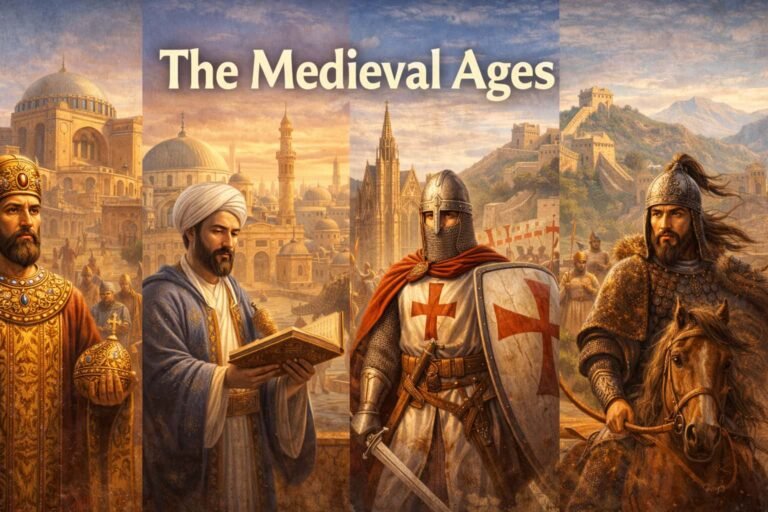
Explore the Medieval Ages across the world—from Byzantium and the Islamic Golden Age to Song China, the Mongols, medieval Europe, and the Americas—in a global perspective.
- Introduction
- The Byzantine Empire
- The European Middle Ages
- The Origins of Islam and the Islamic Golden Age
- The Great Schism
- The Crusades
- The Mongol World
- Song China
- Medieval Japan
- Medieval Civilizations of the Americas
- Trade, Cities, and Economic Change
- Financial Institutions and Economic Innovation
- Disease, Demography, and Migration
- Social, Political, and Environmental Patterns Compared
- Conclusion: The Legacy of the Medieval Ages
Introduction
The Medieval Ages, often called the Middle Ages, refer to a broad and diverse period in world history that followed the classical civilizations of antiquity and preceded the early modern era. Roughly spanning from around the 5th century to the 15th century, the Medieval Ages were not a single, uniform age but a collection of overlapping regional histories shaped by environment, culture, religion, and political organization.
In Europe, the Medieval Ages are often dated from the fall of the Western Roman Empire in the 5th century to the Renaissance around the 15th century. In other parts of the world, however, the timeline looks very different. China, the Islamic world, the Americas, and Japan followed their own historical rhythms, and many regions experienced growth and innovation during periods when Europe struggled politically.
One of the most persistent misconceptions about the Medieval Ages is the idea of a global “Dark Ages.” This term, once used by early modern European writers, suggests a period of decline, ignorance, and stagnation. Modern scholarship has largely rejected this view. While some regions faced political fragmentation or population decline, others experienced cultural flowering, scientific advancement, and expanding trade networks.
The Medieval Ages formed a crucial bridge between ancient civilizations and the modern world. During this time, major world religions spread, new political systems emerged, long-distance trade intensified, and societies adapted to environmental pressures in creative ways. Understanding the medieval world helps explain the roots of modern states, economies, and cultural traditions.
The Byzantine Empire
Roman Continuity in the Eastern Mediterranean
The Byzantine Empire was the continuation of the Roman Empire in the eastern Mediterranean after the collapse of Roman rule in the West. Centered on Constantinople (modern Istanbul), it preserved Roman law, administration, and imperial identity for nearly a thousand years after Rome fell.
Political Structure and Imperial Authority
Byzantine emperors ruled as absolute monarchs, combining political and religious authority. They relied on a professional bureaucracy, a standing army, and complex diplomacy to manage their territory, which stretched across southeastern Europe and the eastern Mediterranean at various times.
Orthodox Christianity and Religious Life
Christianity shaped Byzantine society deeply. The emperor was seen as God’s representative on Earth, and religious disputes often had political consequences. The development of Eastern Orthodox Christianity became a defining feature of Byzantine culture.
Economy, Trade, and Urban Culture
Constantinople was one of the largest and wealthiest cities of the medieval world. Its location made it a hub for trade between Europe and Asia, dealing in silk, spices, grain, and luxury goods.
Environmental and Geographic Advantages
Protected by strong walls and surrounded by water, Constantinople benefited from natural defenses. Its access to fertile lands and trade routes helped sustain the empire through centuries of conflict.
Byzantine Influence
Byzantine art, law, and religious traditions influenced Eastern Europe, Russia, and the Islamic world, acting as a cultural bridge between antiquity and the medieval era.
The European Middle Ages
Feudalism and Serfdom
Land-Based Power Systems
After the fall of the Western Roman Empire, political authority in Europe became fragmented. Feudalism emerged as a system based on land ownership and personal relationships rather than centralized state power.
Lords, Vassals, and Obligations
Kings granted land to nobles (lords), who in turn pledged loyalty and military service. Peasants, often called serfs, worked the land in exchange for protection and the right to farm.
Daily Life of Peasants and Nobles
Most people lived in rural villages and worked in agriculture. Life was shaped by seasonal cycles, local customs, and limited mobility. Nobles lived more comfortably but were bound by obligations of warfare and governance.
Limits and Regional Variations
Feudalism was not universal or uniform. Its structure varied widely across Europe, and some regions retained stronger central authority than others.
The Origins of Islam and the Islamic Golden Age
Rise of Islam in the Arabian Peninsula
Islam emerged in the 7th century in the Arabian Peninsula. The teachings of the Prophet Muhammad emphasized monotheism, social justice, and moral responsibility.
Political and Religious Foundations
After Muhammad’s death, Islamic leaders, known as caliphs, built an empire that spread rapidly across the Middle East, North Africa, and parts of Europe and Asia.
Caliphates and Governance
Islamic states combined religious principles with practical administration. They tolerated religious diversity, allowing Jews and Christians to practice their faiths under Islamic rule.
Science, Medicine, Philosophy, and Learning
During the Islamic Golden Age, scholars made major advances in mathematics, astronomy, medicine, and philosophy. Ancient Greek and Roman texts were preserved and expanded upon.
Social Institutions
Hospitals, schools, libraries, and charitable institutions were widespread. Urban life flourished in cities like Baghdad, Cairo, and Córdoba.
Trade Networks and Urban Life
Islamic merchants connected Africa, Asia, and Europe through extensive trade routes, spreading goods and ideas across continents.
The Great Schism
Background and Causes
In 1054, tensions between the Christian churches of Rome and Constantinople led to the Great Schism, dividing Christianity into Roman Catholicism and Eastern Orthodoxy.
Differences Between East and West
Disagreements involved theology, church authority, and cultural practices. Language differences—Latin in the West and Greek in the East—deepened the divide.
Political and Cultural Consequences
The schism weakened Christian unity and contributed to later conflicts, including tensions during the Crusades.
Long-Term Impact
The division between Eastern and Western Christianity continues to shape religious and cultural identities today.
The Crusades
Causes and Motivations
The Crusades were a series of religiously motivated wars launched by European Christians to regain control of Jerusalem and other sacred sites.
Religious, Political, and Economic Factors
While religion played a central role, crusading was also driven by political ambition, social pressures, and economic opportunity.
Interactions Between Communities
Crusades brought Christians, Muslims, and Jews into prolonged contact—sometimes violent, sometimes cooperative—leading to cultural exchange as well as destruction.
Consequences
The Crusades affected Europe, Byzantium, and the Islamic world, altering trade routes, political alliances, and cultural perceptions.
The Mongol World
Rise of the Mongol Empire
In the 13th century, the Mongols created the largest contiguous land empire in history. Their success was based on mobility, discipline, and adaptability.
Political Organization and Military Strategy
Mongol rulers combined harsh military tactics with effective administration. They recruited officials from many cultures.
Cultural Tolerance and Administration
The Mongols often tolerated local religions and customs, focusing on loyalty and taxation rather than cultural conformity.
Trade and the Pax Mongolica
Under Mongol rule, trade along the Silk Road flourished, connecting China, the Middle East, and Europe.
Environmental Adaptation
Nomadic lifestyles allowed the Mongols to thrive in harsh environments and move rapidly across vast territories.
Song China
Political Institutions and Bureaucracy
The Song dynasty ruled China through a sophisticated bureaucracy based on civil service exams rather than noble birth.
Economic Growth and Technological Innovation
Song China saw major advances in printing, navigation, gunpowder, and agriculture, supporting population growth and urbanization.
Urbanization and Commerce
Cities became centers of trade, craftsmanship, and culture. Markets and merchant activity expanded dramatically.
Environmental Management
Irrigation, flood control, and rice cultivation were essential to sustaining large populations.
Cultural and Intellectual Life
Confucian philosophy guided governance, education, and family life.
Medieval Japan
Political Structure and Feudal Order
Medieval Japan developed a feudal system led by military rulers called shoguns, while emperors remained symbolic figures.
Samurai and Authority
Samurai warriors served local lords and followed codes emphasizing loyalty and honor.
Social Hierarchy and Family Life
Family lineage and landholding shaped social status. Women’s roles varied by class and period.
Religious Traditions
Shinto and Buddhism influenced Japanese values, rituals, and views of nature.
Environmental Constraints
Japan’s mountainous terrain and limited farmland shaped settlement patterns and political organization.
Medieval Civilizations of the Americas
Maya
The Maya developed city-states with advanced writing, astronomy, and ritual practices. Environmental pressures contributed to political instability in some regions.
Aztec
The Aztec built a powerful empire based on tribute and military expansion. Their capital, Tenochtitlán, was a marvel of urban planning and water management.
Inca
The Inca created a centralized state in the Andes, building roads, terraces, and storehouses to manage resources across extreme environments.
Trade, Cities, and Economic Change
The medieval world saw the rise of new trading cities and expanding commercial networks. The Silk Road and maritime routes connected distant regions, enabling the exchange of goods, technologies, and ideas.
Financial Institutions and Economic Innovation
Medieval societies developed early banking systems, credit arrangements, and commercial contracts. These innovations supported long-distance trade and urban growth.
Disease, Demography, and Migration
Disease
The Black Death of the 14th century dramatically reduced populations across Eurasia, reshaping economies and social structures.
Demography and Migration
Population shifts, labor shortages, and migration altered political and economic relationships.
Environment and Health
Climate fluctuations and environmental conditions influenced disease spread and food production.
Social, Political, and Environmental Patterns Compared
Across the Medieval Ages, societies faced common challenges:
- Managing resources
- Organizing power
- Adapting to environments
Differences emerged from geography, culture, and historical context, demonstrating human resilience and creativity.
Conclusion: The Legacy of the Medieval Ages
The Medieval Ages were a time of transformation, connection, and innovation. Far from being a stagnant era, they laid the foundations for modern states, global trade, religious traditions, and cultural exchange. By examining the medieval world globally, we gain a deeper understanding of humanity’s shared past and the complex paths that shaped the modern world.