

Introduction
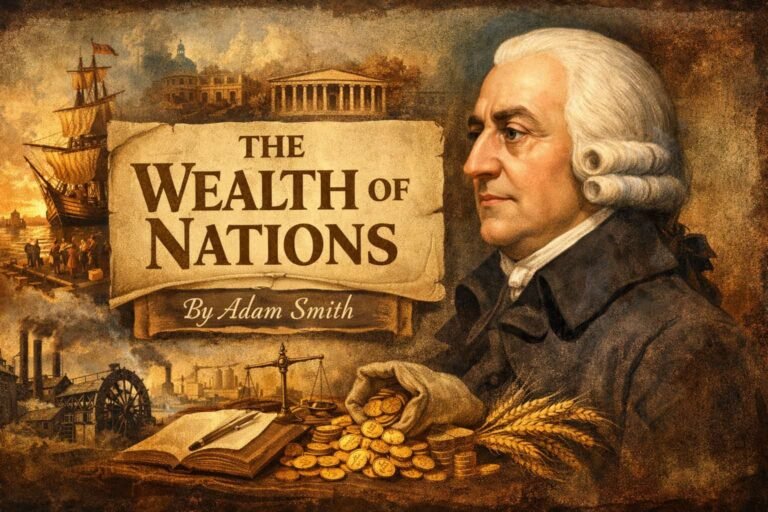
Few books have shaped the modern world as profoundly as Adam Smith’s The Wealth of Nations. First published in 1776, the same year as the American Declaration of Independence, this monumental work laid the intellectual foundations of capitalism as an economic system driven by markets, competition, and individual choice. For readers searching for a deep yet accessible understanding of capitalism—how it works, why it emerged, and what it means for societies—The Wealth of Nations remains essential reading.
- Introduction
- Brief Overview of the Book
- Why The Wealth of Nations Matters for Understanding Capitalism
- About Adam Smith
- Historical and Cultural Context
- Book I: How Capitalism Begins with Labor, Value, and Exchange
- Book II: Capital Accumulation and the Structure of a Capitalist Economy
- Book III: Why Some Nations Prosper Under Capitalism and Others Do Not
- Book IV: Capitalism Versus Mercantilism
- Book V: The Role of Government in a Capitalist Society
- Main Themes and Key Concepts
- Why The Wealth of Nations Is Still Relevant Today
- Conclusion: A Timeless Guide to Capitalism
- Frequently Asked Questions (FAQ)
Smith did not write a technical manual for economists. He wrote a sweeping explanation of how people produce, exchange, and distribute wealth, and why nations prosper or stagnate. This summary offers a comprehensive, engaging guide to the book’s arguments, historical context, and enduring relevance, helping modern readers grasp why capitalism continues to shape global life.
Brief Overview of the Book
An Inquiry into the Nature and Causes of the Wealth of Nations, commonly known as The Wealth of Nations, is a five-book exploration of economic life. Adam Smith examines how labor, markets, trade, money, and government policy interact to create wealth. He challenges older systems of economic control, particularly mercantilism, and argues that societies grow richer when individuals are free to pursue productive activity within competitive markets.
Rather than presenting abstract formulas, Smith uses everyday examples—pin factories, farming, trade routes, and taxes—to explain complex ideas. His central claim is that economic prosperity arises not from hoarding gold or strict regulation, but from productivity, specialization, and voluntary exchange. These ideas became the intellectual backbone of modern capitalism.
Why The Wealth of Nations Matters for Understanding Capitalism
The book matters because it explains capitalism not as an ideology imposed from above, but as a natural outcome of human cooperation under conditions of freedom and law. Smith shows how decentralized decision-making—millions of individuals pursuing their own livelihoods—can generate order, efficiency, and wealth without central planning.
For anyone trying to understand debates about free markets, inequality, globalization, or the role of government, The Wealth of Nations provides the original framework from which many modern arguments descend. It helps readers see capitalism as a dynamic process rather than a static doctrine.
About Adam Smith
A Short Biography
Adam Smith was born in 1723 in Kirkcaldy, Scotland, and became one of the central figures of the Scottish Enlightenment. He studied philosophy at the University of Glasgow and later at Oxford, eventually becoming a professor of moral philosophy. Long before writing about economics, Smith was deeply concerned with ethics, social order, and human behavior.
His earlier work, The Theory of Moral Sentiments, explored sympathy, morality, and the psychological foundations of social life. These concerns carried directly into The Wealth of Nations, where economic behavior is always tied to human motivations and social institutions.
Intellectual Context
Smith lived in a period of rapid change. Trade was expanding, manufacturing was growing, and traditional feudal structures were breaking down. Enlightenment thinkers emphasized reason, observation, and natural laws, and Smith applied these methods to economic life. His goal was not to defend the rich or attack the poor, but to explain how economic systems actually function and how they might promote general prosperity.
Historical and Cultural Context
When and Why the Book Was Written
The Wealth of Nations was published in 1776 after nearly two decades of research and revision. At the time, European governments followed mercantilism, a system focused on accumulating precious metals, controlling trade, and protecting domestic industries through monopolies and tariffs. Smith believed these policies hindered growth and enriched narrow interests at the expense of society.
The book was written as both a critique of existing policies and a proposal for a new way of thinking about wealth—one grounded in productivity, labor, and exchange rather than state control.
Social and Political Influences
The rise of commerce, colonial trade, and early industrialization deeply influenced Smith’s thinking. He observed how cities engaged in trade grew richer than isolated regions, and how specialization increased output. Politically, Britain was expanding its empire and grappling with questions of taxation, governance, and trade regulation. Smith’s work addressed these real-world concerns with striking clarity.
The book was influential almost immediately, shaping debates in Britain and beyond. Policymakers and intellectuals engaged seriously with Smith’s arguments, even when they disagreed.
The Wealth of Nations became the foundation of classical economics and deeply influenced thinkers such as David Ricardo, Karl Marx, and John Stuart Mill. Its ideas underpin modern capitalism, free trade theory, and economic policy worldwide.
Book I: How Capitalism Begins with Labor, Value, and Exchange
Book I lays the intellectual foundation for Adam Smith’s explanation of capitalism. It is here that he introduces the core mechanisms that allow economies to grow: specialization, exchange, wages, profits, and rents. Smith’s goal is to explain how productive capacity increases and how wealth is distributed among different social groups.
The Division of Labor: The Engine of Capitalism
Smith begins with the idea that the greatest improvement in productivity comes from the division of labor. Instead of individuals producing goods entirely on their own, capitalism encourages people to specialize in narrow tasks. Smith famously illustrates this with a pin factory, showing how dividing production into many small steps allows workers to produce thousands of pins per day rather than just a handful.
This specialization improves output in three ways:
- Workers become more skilled at their specific task.
- Time is saved by eliminating constant switching between tasks.
- Specialized work encourages the invention of machines and tools.
Smith emphasizes that the division of labor is not imposed by governments. It arises naturally from the human tendency to trade. Capitalism, in this sense, is a system built on voluntary cooperation.
Markets, Exchange, and Human Nature
Smith argues that humans are not motivated solely by generosity. Instead, economic exchange relies on mutual self-interest. When people trade, they do so because both expect to benefit. This insight challenges earlier moral views that saw commerce as morally suspect.
Under capitalism, individuals do not need to care about the personal welfare of everyone they trade with. The structure of markets ensures cooperation without requiring deep trust or altruism. This insight becomes one of the defining features of capitalist thought.
Value, Price, and the Origins of Wealth
Smith distinguishes between:
- Value in use (how useful something is)
- Value in exchange (how much it can buy in trade)
He explains that labor is the original source of value, especially in early societies. As capitalism develops, prices come to reflect wages, profits, and rents rather than labor alone.
Smith also introduces the idea of a natural price, which reflects the real costs of production, and a market price, which fluctuates based on supply and demand. Competition, a key feature of capitalism, pushes market prices toward natural prices over time.
Wages, Profits, and Rents
Smith analyzes how wealth is distributed among:
- Workers (wages)
- Capital owners (profits)
- Landowners (rents)
He argues that wages tend to rise in growing economies and fall in stagnant ones. Profits are a reward for risk and investment but tend to decline as competition increases. Rent, in contrast, often benefits landowners without corresponding effort, a point that later critics of capitalism would seize upon.
Book I concludes by establishing capitalism as a system driven by labor productivity, voluntary exchange, and competitive markets.
Book II: Capital Accumulation and the Structure of a Capitalist Economy
Book II focuses on capital, which Smith calls “stock.” This section explains how saving, investment, and capital allocation determine whether capitalism produces long-term prosperity or stagnation.
What Capital Is and Why It Matters
Smith defines capital as accumulated resources used to generate future income. Unlike wealth consumed immediately, capital is reinvested to expand production. This reinvestment is the backbone of capitalism.
He explains that societies grow wealthier not by spending more, but by saving and investing productively. This insight contradicts the idea that luxury consumption drives prosperity.
Fixed and Circulating Capital
Smith divides capital into:
- Fixed capital: machinery, tools, buildings, and skills
- Circulating capital: wages, raw materials, and goods in transit
A healthy capitalist economy maintains a balance between these forms. Too much emphasis on luxury goods or idle wealth slows growth.
Productive vs. Unproductive Labor
Smith controversially distinguishes between labor that creates tangible value (productive) and labor that does not add lasting output (unproductive). While modern economics views services differently, Smith’s core point is that capitalism grows through activities that expand productive capacity, not mere consumption.
Money and Capitalism
Smith views money not as wealth itself, but as a tool that facilitates exchange. Hoarding money does not enrich a nation; investing it productively does. This argument directly challenges mercantilist beliefs and reinforces capitalism’s focus on production rather than accumulation of currency.
Book III: Why Some Nations Prosper Under Capitalism and Others Do Not
Book III is historical and comparative. Smith examines why capitalism develops unevenly across societies.
The Natural Order of Economic Development
Smith argues that economies tend to develop in this sequence:
- Agriculture
- Manufacturing
- Trade and commerce
When governments interfere with this order—by favoring urban merchants over farmers, for example—economic development becomes distorted.
Europe vs. the Colonies
Smith contrasts Europe’s slow development with the rapid growth of colonies in North America. In colonies, land was abundant, labor was rewarded, and feudal institutions were weaker. These conditions allowed capitalism to flourish more naturally.
This analysis shows that capitalism thrives where individuals can freely use land, labor, and capital without oppressive restrictions.
Book IV: Capitalism Versus Mercantilism
Book IV is Smith’s most polemical section. It directly attacks mercantilism and defends free markets and free trade.
The Failures of Mercantilism
Smith criticizes mercantilism for equating wealth with gold and silver. He argues that trade restrictions, tariffs, and monopolies reduce overall prosperity by protecting inefficient producers.
Under mercantilism, governments often favor merchants and manufacturers at the expense of consumers. Smith exposes this as a distortion of capitalism that benefits narrow interests.
The Case for Free Trade
Smith argues that when nations specialize in what they do best and trade freely, all parties gain. Trade expands markets, deepens specialization, and increases productivity.
He does not claim free trade is perfect or always politically easy, but he insists it is economically superior to protectionism.
Colonies and Empire
Smith criticizes colonial monopolies and argues that empires are expensive and inefficient. He suggests that voluntary trade would be more beneficial than political domination—an idea far ahead of its time.
Book V: The Role of Government in a Capitalist Society
Book V, titled Of the Revenue of the Sovereign or Commonwealth, is the culmination of Adam Smith’s argument. After explaining how markets, labor, and capital generate wealth, Smith turns to a critical question: What must the government do for capitalism to function sustainably?
Far from advocating an absence of government, Smith outlines a robust and carefully limited role for the state. He argues that capitalism depends on strong public institutions, fair taxation, and social investments that markets alone cannot provide.
Smith begins Book V by defining three essential duties of the sovereign. These duties are not optional; they are foundational to a functioning capitalist system.
1. National Defense
Smith argues that protecting society from external threats is the first responsibility of government. Markets cannot provide national defense because individuals cannot be excluded from its benefits, and private provision would be inefficient and unstable.
Importantly, Smith notes that as societies become more commercial, citizens become less militarily capable due to specialization. In earlier societies, citizens were also soldiers. In capitalist societies, professional armies become necessary.
This insight highlights a recurring theme in Book V: capitalism creates wealth but also vulnerabilities, which government must address.
2. Administration of Justice
The second duty of government is maintaining justice—specifically, protecting individuals’ property rights and enforcing contracts.
Smith emphasizes that capitalism depends on trust:
- Trust that property will not be arbitrarily seized
- Trust that contracts will be enforced
- Trust that laws apply equally
Without a reliable legal system, capital accumulation collapses because people will not invest or innovate. Smith openly acknowledges that laws often favor property owners, but he insists that predictable, impartial justice is essential for economic growth.
In this sense, capitalism is not a natural free-for-all. It is a system built on legal order.
3. Public Works and Institutions
The third duty is the most expansive and controversial. Smith argues that government must provide public works and institutions that are:
- Essential to society
- Beneficial to commerce
- Unlikely to be provided profitably by private individuals
These include:
- Roads, bridges, canals, and harbors
- Infrastructure that reduces transaction costs
- Institutions that facilitate trade and mobility
Smith is pragmatic rather than ideological. If private actors can provide these efficiently, he supports it. If not, public funding is justified.
This is a crucial corrective to simplistic interpretations of capitalism as anti-government.
Public Infrastructure and Economic Growth
Smith devotes significant attention to infrastructure because it directly affects productivity.
Better roads and ports:
- Expand markets
- Encourage specialization
- Reduce transportation costs
- Integrate rural and urban economies
He argues that infrastructure investments often pay for themselves by increasing trade and tax revenue. Capitalism, therefore, benefits from strategic public spending, not just private investment.
Education and the Moral Limits of Capitalism
One of the most striking parts of Book V is Smith’s concern for education and mental well-being.
The Problem of Extreme Specialization
Smith recognizes a downside of the division of labor. When workers repeat narrow tasks endlessly, they risk becoming intellectually and morally diminished. He warns that such workers may lose:
- Curiosity
- Judgment
- Civic engagement
This is a remarkable acknowledgment of capitalism’s social costs.
Public Education as a Solution
To counteract this, Smith supports publicly funded education, especially basic literacy and numeracy. He believes education:
- Improves productivity
- Strengthens democracy
- Prevents social unrest
- Preserves human dignity
Smith argues that even minimal education dramatically improves social stability. This position sharply contrasts with portrayals of him as indifferent to social welfare.
Religion, Morality, and Social Order
Smith also discusses religious institutions, not as theological authorities, but as social stabilizers.
He argues that competition among religious groups can moderate extremism and prevent any single institution from becoming oppressive. This mirrors his economic views: competition fosters moderation and accountability.
Religion, education, and law together form a moral framework that capitalism alone cannot supply.
Taxation: How Capitalism Should Fund Government
A large portion of Book V is devoted to taxation, making it one of the earliest systematic analyses of public finance.
The Four Principles of Taxation
Smith outlines four maxims that remain influential today:
- Equity – Citizens should contribute according to their ability to pay.
- Certainty – Taxes should be clear and predictable.
- Convenience – Taxes should be collected in a way that minimizes burden.
- Efficiency – Taxes should cost little to administer and avoid distorting incentives.
These principles are still cited in modern discussions of capitalist tax policy.
Progressive Taxation and Fairness
Contrary to popular belief, Smith supports progressive taxation. He argues that the wealthy benefit disproportionately from social stability and infrastructure and should therefore contribute more.
He criticizes regressive taxes that burden the poor while protecting elites—demonstrating that his vision of capitalism includes moral considerations.
Critique of Arbitrary and Hidden Taxes
Smith strongly opposes taxes that are unpredictable or disguised. Such taxes create uncertainty, discourage investment, and undermine trust in government—damaging capitalism from within.
Transparency, for Smith, is an economic virtue.
Public Debt and Fiscal Responsibility
Smith warns against excessive public debt. While he accepts borrowing for emergencies like war, he argues that chronic debt burdens future generations and distorts political incentives.
His concern is not austerity for its own sake, but long-term economic sustainability.
Capitalism, Government, and Balance
Book V makes clear that Smith’s capitalism is not anarchic. It requires:
- Law
- Education
- Infrastructure
- Defense
- Fair taxation
Markets generate wealth, but governments preserve the conditions under which markets can function.
Smith rejects both extremes:
- Total state control (which stifles productivity)
- Total laissez-faire neglect (which undermines social order)
His vision is a balanced capitalist society guided by institutions that support freedom while mitigating its excesses.
Main Themes and Key Concepts
Capitalism as a System of Cooperation
At its core, The Wealth of Nations presents capitalism as a system where individuals cooperate through exchange rather than command. Prices convey information, guiding resources to their most valued uses.
Self-Interest and Social Benefit
Smith famously argues that individuals pursuing their own interests can unintentionally promote social good. This is often summarized as the “invisible hand,” though the phrase appears sparingly. The deeper idea is that structured competition channels self-interest into productive outcomes.
Productivity and Growth
Wealth grows through improved productivity, not mere redistribution. Innovation, specialization, and investment drive long-term progress.
The Invisible Hand
Smith suggests that individuals, by seeking their own advantage, are led to contribute to society’s wealth as if guided by an unseen force. This is not a claim that markets are perfect, but that decentralized decision-making often outperforms central control.
Natural Price vs. Market Price
Smith distinguishes between the natural price—reflecting costs of production—and the market price, which fluctuates with supply and demand. Competition tends to align the two over time.
Important Ideas
- Wealth consists of goods and services that satisfy human needs.
- Labor is the source of value, though capital and land shape distribution.
- Trade restrictions usually benefit producers at consumers’ expense.
- Government has a vital but limited role in supporting markets.
Why The Wealth of Nations Is Still Relevant Today
Capitalism in the Modern World
Globalization, technological change, and debates over inequality echo Smith’s concerns. His insights into specialization, trade, and institutional support remain central to understanding modern capitalism.
The Wealth of Nations is not a moral defense of greed. It is an analysis of how societies can organize economic life to maximize prosperity. Smith recognizes moral limits, institutional requirements, and potential failures. Capitalism works best when embedded in a framework of justice, education, and public goods.
Contemporary Issues
Discussions about regulation, taxation, public goods, and market failures all trace back to questions Smith raised. Reading The Wealth of Nations provides historical depth to current economic debates.
Conclusion: A Timeless Guide to Capitalism
The Wealth of Nations endures because it explains capitalism as a living system shaped by human behavior, institutions, and incentives. Adam Smith offers neither blind praise nor outright condemnation, but a careful exploration of how economic freedom can generate wealth when guided by law and moral norms.
For readers seeking to understand capitalism beyond slogans, this book remains unmatched—a cornerstone of economic thought that continues to illuminate the modern world.
Frequently Asked Questions (FAQ)
What is The Wealth of Nations about in simple terms?
It explains how societies create wealth through labor, trade, and markets, and why economic freedom often leads to prosperity.
Is The Wealth of Nations pro-capitalism?
Yes, but critically. Adam Smith supports capitalism while acknowledging the need for regulation and public institutions.
What is the main idea of capitalism in Adam Smith’s view?
Capitalism works best when individuals freely pursue productive activity within competitive markets supported by strong laws.
Is The Wealth of Nations still worth reading today?
Absolutely. Its insights into markets, trade, and government remain highly relevant to modern economic debates.
Did Adam Smith support government intervention?
He supported essential government roles, including defense, justice, infrastructure, and education, within a market economy.