

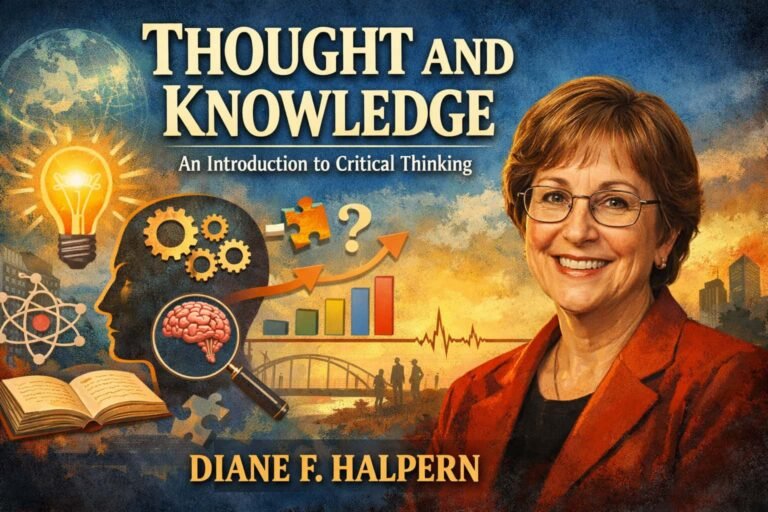
An Introduction to Critical Thinking
Critical Thinking is more than a classroom skill—it is a way of navigating the modern world with clarity, judgment, and intellectual independence. Diane F. Halpern’s influential book, Thought and Knowledge: An Introduction to Critical Thinking, stands as one of the most respected and widely used guides to understanding how people think, reason, decide, and solve problems. Written for both students and general readers, the book explains how human thinking works—and how it can be improved—without resorting to dense academic language.
- An Introduction to Critical Thinking
- Brief Overview of the Book
- Why This Book Matters for Critical Thinking
- About Diane F. Halpern
- Historical and Cultural Context
- Chapter 1: Understanding Critical Thinking — What It Is and Why It Matters
- Chapter 2: Memory, Knowledge, and the Foundations of Critical Thinking
- Chapter 3: Language, Meaning, and How Words Shape Thought
- Chapter 4: Problem Solving — From Confusion to Insight
- Chapter 5: Reasoning — How People Draw Conclusions
- Chapter 6: Decision Making — How Critical Thinking Shapes Choices and Consequences
- Chapter 7: Bias, Error, and the Illusion of Good Thinking
- Chapter 8: Teaching, Learning, and Transferring Critical Thinking
- Main Themes and Key Concepts
- Important Ideas
- Why This Book Is Still Relevant Today
- Conclusion
- Frequently Asked Questions (FAQ)
This comprehensive summary explores the book’s ideas in depth, showing how Critical Thinking connects memory, language, reasoning, creativity, and decision-making into a practical framework for everyday life. Whether you are encountering Halpern’s work for the first time or revisiting it with fresh eyes, this guide is designed to give you a deep, engaging understanding of the book’s insights and lasting relevance.
Brief Overview of the Book
Thought and Knowledge is a foundational text in cognitive psychology and education. Its central goal is to explain how people think—and how they can think better. Diane F. Halpern argues that Critical Thinking is not an abstract talent possessed by a few, but a set of learnable, transferable skills that can be applied across disciplines and real-world situations.
Rather than focusing on philosophy alone, the book integrates research from psychology, neuroscience, education, and behavioral science. It examines how people:
- Acquire and organize knowledge
- Use language to shape thought
- Solve problems and make decisions
- Reason logically—and illogically
- Fall prey to biases and mental shortcuts
The book is structured around key components of thinking, with each section building toward the larger goal of cultivating intentional, reflective, and evidence-based judgment.
The book was widely praised for making complex cognitive research accessible and practical. It quickly became a standard textbook in psychology and education courses.
Long-Term Influence
Thought and Knowledge has shaped:
- How Critical Thinking is taught in schools
- Research on thinking and learning transfer
- Public conversations about reasoning and decision-making
Its influence endures because its insights remain relevant in an information-rich world.
Why This Book Matters for Critical Thinking
In a world saturated with information, misinformation, and persuasive messaging, Critical Thinking is no longer optional. Halpern’s book matters because it:
- Explains why smart people make poor decisions
- Shows how thinking can be improved through practice
- Connects theory to everyday life, from personal choices to public policy
- Emphasizes transfer—using thinking skills beyond the classroom
Unlike many books that define critical thinking vaguely, Thought and Knowledge breaks it into concrete processes and habits of mind. It shows readers not only what good thinking looks like, but how to achieve it.
About Diane F. Halpern
Diane F. Halpern is a distinguished psychologist known for her work on cognition, learning, and Critical Thinking. She has served as a professor of psychology and held leadership roles in major psychological organizations. Her research focuses on how people learn to think effectively and how educational systems can foster better reasoning skills.
Halpern’s approach is practical and evidence-based. She is deeply concerned with the gap between knowing something in theory and applying it in real life. This concern shapes Thought and Knowledge, which consistently emphasizes transferable thinking skills rather than rote learning.
Her influence extends beyond academia into education reform, policy discussions, and public conversations about reasoning and judgment in democratic societies.
Historical and Cultural Context
When and Why the Book Was Written
Thought and Knowledge emerged during a period when educators and psychologists were increasingly concerned about the limits of traditional education. Students were often good at memorizing facts but struggled to apply knowledge in unfamiliar situations. Halpern wrote the book to address this problem directly.
The late 20th century also saw rapid growth in media, advertising, and technology—forces that demanded stronger Critical Thinking skills from citizens. Halpern’s work reflects this urgency, positioning thinking as a survival skill in complex societies.
Intellectual Influences
The book draws from:
- Cognitive psychology’s study of memory, attention, and reasoning
- Educational psychology’s focus on learning transfer
- Behavioral research on bias and decision-making
- Philosophical traditions of logic and rational inquiry
By synthesizing these traditions, Halpern creates a unified framework for understanding thought as both a psychological process and a practical skill.
Chapter 1: Understanding Critical Thinking — What It Is and Why It Matters
Halpern opens the book by confronting a common misconception: that Critical Thinking is vague, intuitive, or synonymous with intelligence. She carefully dismantles this idea and replaces it with a precise, practical definition. Critical thinking, she explains, is purposeful, reasoned, and goal-directed thinking used to solve problems, make decisions, and evaluate claims.
This chapter emphasizes that thinking does not automatically improve with age or education. Without explicit instruction and practice, people often rely on habits, assumptions, and emotional reactions rather than careful reasoning. Halpern introduces the idea that critical thinking must be intentional—people must actively choose to slow down and evaluate their thought processes.
A key concept introduced here is transfer. Skills learned in one context (such as a classroom) are often not applied in others (such as daily life). Halpern argues that true critical thinking only exists when people can recognize when a skill is needed and apply it appropriately in new situations.
The chapter also introduces metacognition, or thinking about one’s own thinking. Readers are encouraged to become observers of their mental processes, asking questions such as: Why do I believe this? What evidence supports it? What alternatives exist?
By the end of the chapter, critical thinking is framed not as a luxury or academic exercise, but as a life skill essential for informed citizenship, personal success, and intellectual independence.
Chapter 2: Memory, Knowledge, and the Foundations of Critical Thinking
This chapter explores how memory works and why it plays a central role in critical thinking. Halpern explains that thinking cannot occur in a vacuum—it depends on what we know and how that knowledge is stored.
Memory, she explains, is reconstructive rather than reproductive. People do not retrieve exact copies of past experiences; instead, they reconstruct memories using fragments of information, expectations, and prior beliefs. This makes memory powerful but also vulnerable to distortion.
Halpern discusses how schemas—organized frameworks of knowledge—help people interpret new information quickly. While schemas make thinking efficient, they can also lead to errors when people overlook information that doesn’t fit their expectations. This tension between efficiency and accuracy is a recurring theme in the book.
The chapter also addresses misconceptions and faulty knowledge. Incorrect beliefs can persist even in the face of contradictory evidence, especially when they are emotionally charged or reinforced by social groups. Critical thinking requires not only acquiring new information but also revising or discarding incorrect knowledge.
Halpern emphasizes strategies for improving memory and knowledge organization, such as elaboration, meaningful connections, and active engagement. Strong knowledge structures, she argues, provide the raw material that critical thinking depends on.
Chapter 3: Language, Meaning, and How Words Shape Thought
Language is presented here as a powerful cognitive tool that both enables and constrains thinking. Halpern explains that words do not merely describe reality—they shape how people perceive and interpret it.
This chapter examines how ambiguity, vagueness, and emotionally loaded language can obscure meaning and manipulate judgment. Readers are shown how the same idea can produce different reactions depending on how it is framed.
Halpern explores the role of definitions, emphasizing that disagreements often arise not from facts but from differing interpretations of key terms. Critical thinkers must learn to ask for clarification and define concepts precisely before evaluating arguments.
The chapter also addresses persuasive language, especially in advertising, politics, and media. Euphemisms, slogans, and selective wording can subtly influence beliefs without appearing overtly deceptive. Recognizing these tactics is essential for critical thinking in everyday life.
Ultimately, Halpern argues that careful attention to language improves reasoning by reducing confusion, uncovering hidden assumptions, and clarifying intent.
Chapter 4: Problem Solving — From Confusion to Insight
Problem solving is one of the most visible applications of critical thinking, and this chapter breaks it down into manageable stages. Halpern explains that many failures in problem solving occur not because people lack intelligence, but because they misidentify the problem.
Readers are guided through the steps of effective problem solving:
- Defining the problem clearly
- Generating possible solutions
- Evaluating alternatives
- Implementing and monitoring outcomes
Halpern introduces common obstacles such as mental set—the tendency to rely on familiar strategies even when they are ineffective—and functional fixedness, which limits how people perceive the use of objects or ideas.
The chapter also explores the relationship between problem solving and creativity. Creative thinking involves generating many possibilities, while critical thinking evaluates and refines them. The two processes are complementary, not contradictory.
Real-world examples illustrate how flexible thinking, analogy, and representation can lead to breakthroughs when standard approaches fail.
Chapter 5: Reasoning — How People Draw Conclusions
This chapter focuses on reasoning, the process of moving from information to conclusions. Halpern distinguishes between deductive reasoning, which aims for certainty, and inductive reasoning, which deals in probabilities.
Rather than emphasizing formal logic alone, the chapter focuses on how reasoning actually occurs in everyday life. Halpern explains why people often accept conclusions that feel right, even when they are poorly supported.
Common reasoning errors are explored, including:
- Overgeneralization
- Confusing correlation with causation
- Ignoring base rates
Critical thinking requires evaluating the strength of evidence, considering alternative explanations, and recognizing uncertainty.
Halpern stresses that good reasoning does not guarantee correct conclusions—but it increases the likelihood of making justified and defensible judgments.
Chapter 6: Decision Making — How Critical Thinking Shapes Choices and Consequences
Chapter 6 represents one of the most practically important sections of Thought and Knowledge, because decision making is where Critical Thinking moves from theory into daily life. Halpern begins by emphasizing that decisions are unavoidable. From small, routine choices to life-altering commitments, people are constantly selecting among alternatives—often without realizing how their thinking processes guide those choices.
A central argument of this chapter is that most decisions are not made through careful analysis, even when the stakes are high. Instead, people rely on shortcuts, emotions, habits, and social cues. These shortcuts, known as heuristics, exist because the human brain is not designed to calculate every option exhaustively. In many cases, heuristics are efficient and adaptive. However, they can also systematically distort judgment.
Halpern explores how people assess risk and uncertainty, showing that individuals are often poor intuitive statisticians. For example, people tend to:
- Overestimate dramatic or memorable risks
- Underestimate common but less visible dangers
- Focus on short-term outcomes rather than long-term consequences
These tendencies explain why people may fear rare events while ignoring everyday risks, or why they make decisions that feel good in the moment but lead to regret later.
A major portion of the chapter is devoted to framing effects, one of the most powerful demonstrations of how decision making can be manipulated. Halpern explains that the way options are presented—whether in terms of gains or losses—can significantly influence choices, even when the underlying information is identical. This insight has profound implications for fields such as marketing, politics, healthcare, and public policy.
Emotion plays a critical role in decision making, and Halpern does not portray emotion as the enemy of reason. Instead, she explains that emotions often act as signals, helping people prioritize what matters. Problems arise when emotions dominate without reflection or when people mistake emotional intensity for evidence. Critical Thinking requires recognizing emotional influences without suppressing them entirely.
The chapter also examines group decision making, highlighting how social pressure, conformity, and authority can undermine independent judgment. People often assume that consensus implies correctness, even when groups are poorly informed or biased.
Halpern concludes by offering strategies for improving decision quality through critical thinking, including:
- Clearly identifying goals
- Generating multiple alternatives
- Evaluating evidence rather than intuition alone
- Considering opportunity costs
- Reflecting on outcomes to improve future decisions
The overarching message is clear: Critical Thinking does not eliminate uncertainty, but it helps people make better, more defensible decisions in an uncertain world.
Chapter 7: Bias, Error, and the Illusion of Good Thinking
Chapter 7 confronts a humbling truth: even when people believe they are thinking critically, they are often mistaken. Halpern explains that human cognition is systematically biased—not occasionally flawed, but predictably imperfect. This chapter serves as both a warning and an invitation: understanding these biases is essential for genuine Critical Thinking.
One of the chapter’s key insights is that confidence is not a reliable indicator of accuracy. People frequently feel certain about judgments that are objectively incorrect. This illusion of knowing makes bias particularly dangerous, because individuals rarely recognize when their thinking has gone astray.
Halpern explores a range of cognitive biases, beginning with confirmation bias—the tendency to seek, interpret, and remember information that supports existing beliefs while ignoring contradictory evidence. This bias explains why debates often harden opinions rather than change them and why people can consume large amounts of information without becoming better informed.
Another major focus is overconfidence, which leads people to overestimate their knowledge, abilities, and predictive accuracy. Overconfidence affects professionals, experts, and novices alike, influencing decisions in medicine, finance, education, and leadership.
The chapter also examines hindsight bias, the tendency to believe after the fact that outcomes were predictable all along. This bias distorts learning because it prevents people from accurately evaluating past decisions. If everything seems obvious in retrospect, there is little motivation to improve thinking strategies.
Halpern emphasizes that biases persist even when people are aware of them. Simply knowing about a bias does not automatically prevent it. This insight reinforces the book’s broader message: Critical Thinking requires deliberate effort and structured strategies, not just good intentions.
The chapter highlights techniques for reducing bias, such as:
- Actively seeking opposing viewpoints
- Slowing down reasoning processes
- Separating evidence from interpretation
- Using external checks and feedback
Rather than portraying bias as a personal flaw, Halpern frames it as a design feature of human cognition—one that must be managed thoughtfully. Effective critical thinkers are not bias-free; they are bias-aware and bias-resistant.
Chapter 8: Teaching, Learning, and Transferring Critical Thinking
The final chapter brings the book’s ideas full circle by focusing on how Critical Thinking can be taught, learned, and sustained over time. Halpern returns to the concept of transfer, arguing that thinking skills are valuable only if they are used beyond the context in which they were learned.
A major claim of this chapter is that traditional education often fails to produce critical thinkers because it prioritizes content coverage over cognitive strategy. Students may perform well on exams yet struggle to apply their knowledge to unfamiliar problems. Halpern argues that Critical Thinking must be taught explicitly, not assumed to develop automatically.
The chapter outlines principles for effective instruction, including:
- Teaching thinking skills directly
- Providing varied practice across domains
- Encouraging reflection on thinking processes
- Making the relevance of thinking skills explicit
Halpern emphasizes metacognitive instruction, where learners are taught not just what to think, but how to monitor and regulate their thinking. This includes recognizing when a problem requires careful analysis and selecting appropriate strategies.
Another key theme is motivation. People are more likely to think critically when they see value in doing so. Instruction that connects thinking skills to real-world issues—personal decisions, social problems, ethical dilemmas—promotes engagement and transfer.
The chapter also broadens its scope to consider the societal importance of critical thinking. Halpern argues that democracies depend on citizens who can evaluate evidence, detect manipulation, and make informed judgments. Without widespread critical thinking, societies become vulnerable to misinformation, propaganda, and poor collective decision making.
The book concludes with a hopeful but realistic vision. While perfect reasoning is unattainable, improvement is both possible and necessary. Critical Thinking is framed as a lifelong practice—one that strengthens with awareness, effort, and reflection.
Main Themes and Key Concepts
Critical Thinking as a Skill Set, Not a Trait
One of the book’s central messages is that Critical Thinking is learnable. It is not reserved for experts or intellectual elites.
Transfer and Real-World Application
Halpern repeatedly stresses that thinking skills matter only if they can be applied outside the classroom.
Metacognition and Self-Awareness
Thinking improves when people monitor their own reasoning, question assumptions, and reflect on outcomes.
The Interaction of Emotion and Reason
Rather than dismissing emotion, the book shows how emotions and cognition interact—and how understanding this interaction leads to better judgment.
Metacognition
Awareness of one’s own thinking processes; essential for self-correction.
Bias
Systematic patterns of error that distort judgment.
Framing
How the presentation of information influences decisions.
Transfer
The ability to apply learned skills in new contexts.
Each concept reinforces the book’s overarching message: thinking well requires both knowledge and deliberate practice.
Important Ideas
- Good thinking depends on how knowledge is structured, not just how much is known.
- People are more confident in their judgments than accuracy warrants.
- The way information is framed can be as influential as the information itself.
- Teaching thinking requires explicit instruction and practice across contexts.
These ideas recur throughout the book, building a cohesive framework for Critical Thinking.
At its core, Thought and Knowledge argues that poor thinking is not a personal failure but a predictable outcome of how human cognition works. By understanding these patterns, people can design strategies to think better.
One interpretation emphasizes the book’s democratic impulse: societies depend on citizens who can evaluate claims, resist manipulation, and make informed decisions. Another reading highlights its educational philosophy—learning should prioritize thinking over memorization.
Both interpretations converge on a central insight: improving thought improves life.
Why This Book Is Still Relevant Today
In the age of social media, artificial intelligence, and constant information overload, Critical Thinking is more important than ever. Halpern’s analysis of bias, persuasion, and decision-making feels especially timely.
Modern readers can easily connect the book’s ideas to:
- Online misinformation
- Political polarization
- Consumer decision-making
- Workplace problem solving
The cognitive challenges Halpern describes have not disappeared—they have intensified.
Conclusion
Thought and Knowledge by Diane F. Halpern is a landmark exploration of how people think and how they can think better. By breaking Critical Thinking into understandable, practical components, the book empowers readers to become more reflective, informed, and effective decision-makers.
Its enduring value lies in its balance: grounded in research, yet deeply concerned with real life. For anyone seeking to improve judgment, reasoning, and understanding, this book remains an essential guide—and a powerful reminder that better thinking is both possible and necessary.
Frequently Asked Questions (FAQ)
What is Thought and Knowledge about?
The book explains how people think, reason, solve problems, and make decisions, with a strong focus on developing Critical Thinking skills.
Is this book suitable for beginners?
Yes. It is written in clear, accessible language and does not require prior knowledge of psychology.
What makes Diane F. Halpern’s approach to Critical Thinking unique?
She emphasizes transferable skills—thinking strategies that apply across real-world situations, not just academic settings.
Is Thought and Knowledge still relevant today?
Absolutely. Its insights into bias, decision-making, and reasoning are especially relevant in today’s information-driven world.
Who should read this book?
Students, educators, professionals, and anyone interested in improving judgment, reasoning, and everyday decision-making.