

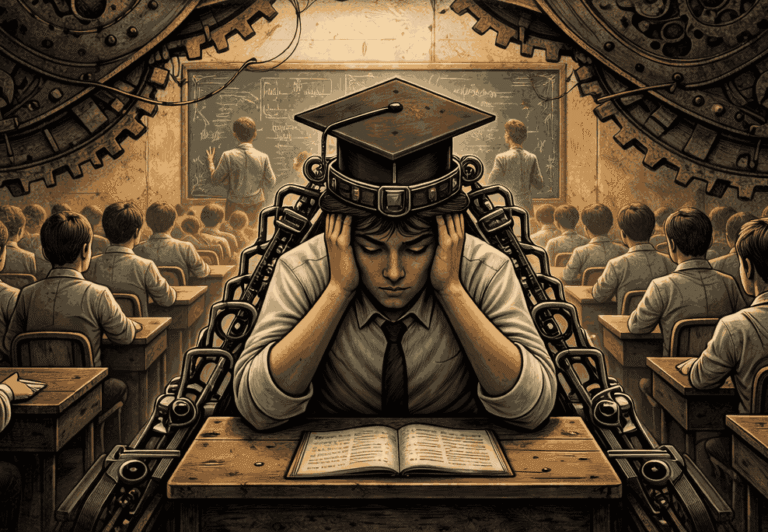
Schooling as Social Reproduction Rather Than Enlightenment
The Myth of Education as Enlightenment
Modern societies proudly present education as the primary engine of enlightenment. Schools and universities are portrayed as spaces where critical thinking is cultivated, curiosity rewarded, and intellectual autonomy encouraged. Governments justify vast educational systems by claiming they produce informed citizens capable of independent judgment. Parents invest years and fortunes believing schooling will help children “learn how to think.”
Yet the lived reality of education tells a different story.
Across disciplines, from philosophy to sociology, from political economy to critical pedagogy, a growing body of thought argues that formal education rarely creates thinkers in the classical sense. Instead, it produces obedient specialists: individuals highly trained in narrow competencies, disciplined in institutional norms, and conditioned to function efficiently within existing power structures.
This article advances a provocative but increasingly defensible claim: education does not primarily cultivate critical thinking; it reproduces social order. Far from being an engine of emancipation, schooling functions as a mechanism of social reproduction—maintaining class hierarchies, economic dependencies, ideological conformity, and political stability.
To explore this thesis, we must examine education not as an abstract moral ideal, but as a concrete social institution embedded within capitalism, bureaucracy, and state power.
What Is Critical Thinking—and Why Schools Rarely Teach It
At its core, critical thinking involves the capacity to question assumptions, evaluate power relations, analyze underlying structures, and resist imposed narratives. Historically, this form of thinking was not institutionalized; it emerged from philosophy, dissent, heresy, and often conflict with authority.
Socrates did not operate within a standardized curriculum. Marx was not credentialed by a ministry of education. Foucault’s work emerged from interrogation of institutions, not obedience to them.
Yet modern education systems redefine critical thinking into something far less threatening.
The Institutional Redefinition of Critical Thinking
In schools, critical thinking is often reduced to:
- Logical problem-solving within predefined parameters
- Evaluating evidence only within accepted frameworks
- Producing arguments that do not challenge foundational assumptions
Students are encouraged to “think critically” about content, but rarely about the system producing that content. One may critique a historical event, but not the political economy of history itself. One may debate policies, but not the legitimacy of the structures imposing them.
True critical thinking destabilizes authority. Institutions, by nature, seek stability.
Education as Social Reproduction: A Sociological Perspective
The French sociologist Pierre Bourdieu offered one of the most influential critiques of education as a system of social reproduction. According to Bourdieu, schools do not neutralize inequality—they legitimize it.
Cultural Capital and Invisible Privilege
Education rewards specific forms of language, behavior, and knowledge that align with dominant classes. Students from privileged backgrounds arrive already fluent in these codes, while others are labeled deficient or “less capable.”
Success appears meritocratic, but it is structurally biased.
Thus, education does not cultivate critical thinking universally—it filters and sorts individuals according to their compatibility with existing hierarchies.
Credentialism Over Understanding
Degrees increasingly function as signals of conformity, not intellectual depth. The question becomes not “Can you think independently?” but “Can you perform according to institutional expectations?”
This shift transforms education into a credential factory, producing obedient specialists optimized for bureaucratic and corporate systems.
The Political Function of Obedient Specialists
Modern economies require specialists—engineers, analysts, managers, technicians—who perform complex tasks without questioning the broader system they serve.
From a political standpoint, this is ideal.
A population trained in narrow expertise but lacking holistic critical thinking is:
- Efficient
- Predictable
- Governable
The specialist understands how to operate within the system, but not why the system exists or who it benefits.
Fragmentation of Knowledge
By dividing knowledge into disciplines, education prevents systemic understanding. Economics is taught without philosophy. Politics without political economy. Technology without ethics.
This fragmentation inhibits critical thinking by design.
When individuals cannot see the whole, they cannot challenge it.
Standardization, Testing, and the Death of Thought
Few forces have damaged critical thinking more than standardized testing.
Tests reward:
- Speed over reflection
- Compliance over creativity
- Memorization over insight
A student who questions the premise of a question risks failure. A student who answers efficiently, even mindlessly, is rewarded.
Surveillance and Discipline
Michel Foucault famously analyzed schools as institutions of discipline—alongside prisons, factories, and hospitals. Timetables, grades, rankings, and constant evaluation train students to internalize surveillance.
They learn to self-regulate, self-censor, and self-optimize.
This produces obedience, not intellectual freedom.
Economic Imperatives: Education for the Labor Market
Education systems increasingly justify themselves in economic terms:
- “Employability”
- “Skills for the future”
- “Human capital”
This framing transforms students into economic units, and learning into investment.
From Thinkers to Workers
Under neoliberal logic, education exists to serve the labor market. Critical thinking is valued only insofar as it increases productivity or innovation—not political awareness or moral critique.
A worker who questions corporate power is a liability.
A worker who questions social inequality is disruptive.
A worker who questions capitalism itself is dangerous.
Thus, education trains individuals to adapt—not to resist.
The Illusion of Choice and Intellectual Freedom
Students are told they have freedom:
- Choose your major
- Choose your electives
- Choose your career path
But these choices occur within tightly constrained economic realities.
Structural Constraints
Debt, job markets, family pressure, and social expectations funnel students toward “practical” paths. Philosophy becomes a luxury. Sociology becomes marginal. Political theory becomes abstract.
Critical thinking survives only at the margins—often stripped of material power.
The University as an Ideological Institution
Universities present themselves as bastions of free thought, yet they depend on:
- State funding
- Corporate sponsorship
- Rankings and metrics
- Market reputation
This dependence shapes what can be thought, researched, and taught.
The Professionalization of Thought
Academics are rewarded for publishing within accepted paradigms, not for challenging foundational assumptions. Radical critique becomes career suicide.
Critical thinking becomes professionalized, sanitized, and contained.
Obedience Disguised as Excellence
The highest-performing students are often the most compliant.
They learn:
- How to please authority
- How to optimize performance
- How to avoid intellectual risk
These students become tomorrow’s managers, administrators, and policymakers—highly competent, deeply trained, and rarely subversive.
The system reproduces itself through them.
What Real Critical Thinking Would Require
If education truly aimed to cultivate critical thinking, it would require:
- Structural literacy (understanding power, class, ideology)
- Interdisciplinary synthesis
- Encouragement of dissent
- Protection for intellectual risk-taking
- Economic security independent of conformity
Such an education would threaten existing systems.
That is precisely why it remains rare.
Alternatives: Education Beyond Obedience
Historically, genuine critical thinking has flourished outside formal education:
- Worker study circles
- Radical reading groups
- Independent intellectual movements
- Underground presses
- Community-based learning
Thinkers emerge despite education, not because of it.
This does not mean schools are useless—but their emancipatory potential is fundamentally constrained.
Conclusion:
Education as It Is vs. Education as It Could Be
The claim that education doesn’t create thinkers—it produces obedient specialists is not cynical pessimism. It is a sociological diagnosis.
Education systems are not broken; they are functioning exactly as designed.
They reproduce:
- Economic hierarchies
- Political stability
- Ideological norms
They reward competence without consciousness, intelligence without autonomy, knowledge without wisdom.
True critical thinking remains dangerous—because it asks not how to succeed within the system, but whether the system deserves to exist at all.
Until education is reimagined not as workforce training or social sorting, but as a genuinely emancipatory practice, it will continue to produce specialists who obey—and thinkers who must emerge elsewhere.