
Question
Are we actually becoming more moral as a society… or are we just better at looking moral? And if our values truly improved, why do the same harms keep reappearing—just in cleaner, more acceptable forms?
Definition
Moral progress is the belief that humanity is ethically improving over time—that we are more just, more compassionate, and more enlightened than those who came before us. This idea suggests a linear movement toward “better values.” But there’s another interpretation: that what changes is not morality itself, but what we find acceptable to see. Under this view, societies don’t abandon harmful behaviors; they redesign them to fit new tastes, norms, and sensitivities. Violence, inequality, and exclusion don’t disappear—they become less visible, less crude, more polite.
Five Keywords You Should Know
- Moral Progress – The belief that ethical standards improve objectively over time. It assumes later generations are morally superior to earlier ones, rather than merely different.
- Aestheticization – The process of making something more acceptable by improving its appearance, language, or presentation—without necessarily changing its underlying reality.
- Norm Shifting – The gradual redefinition of what society considers “normal,” “acceptable,” or “outrageous.” Harm can persist if it blends into the new norm.
- Moral Signaling – The act of expressing correct moral positions publicly to demonstrate virtue, often without meaningful action or personal cost.
- Structural Harm – Damage caused not by individual cruelty, but by systems and institutions that produce suffering while appearing neutral, efficient, or even benevolent.
A Little Bit of History
It’s tempting to look back at history and feel relieved. We abolished slavery (in its most explicit form). We outlawed child labor (mostly). We expanded legal rights. On the surface, this looks like undeniable progress. And in some ways, it is. But look closer and a pattern emerges: the methods change faster than the outcomes.
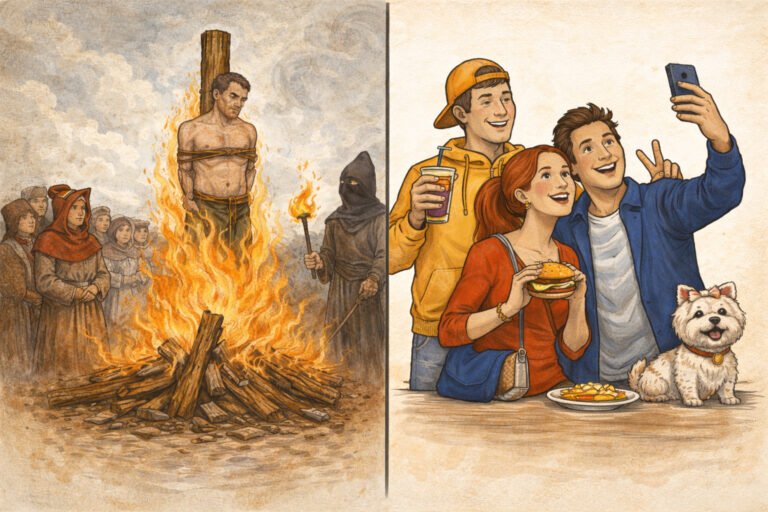
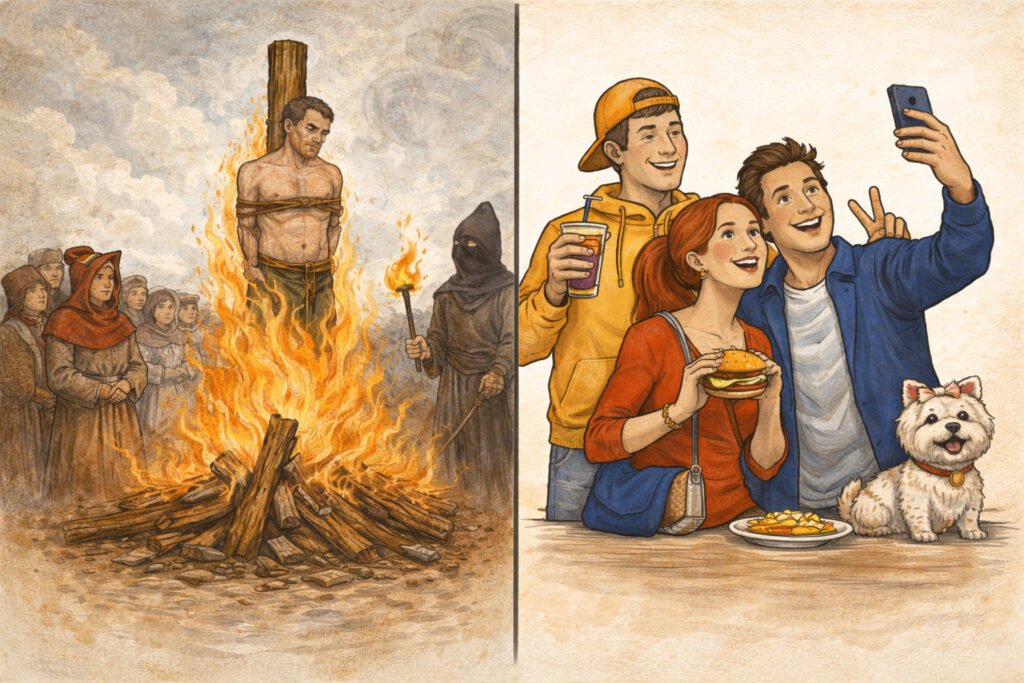
Public executions disappeared, but mass incarceration rose. Colonial empires dissolved, but economic dependency replaced them. Open discrimination became socially unacceptable, but statistical inequality persisted. The language softened. The violence professionalized. The moral discomfort was outsourced or hidden behind institutions.
Each era looks back and says, “At least we’re better than them.” That confidence itself is part of the story.
Precise Examples That Make This Uncomfortable
Example 1: Violence
We no longer cheer at executions in public squares. That feels like progress. Yet modern warfare is conducted remotely, through drones and screens, with civilian casualties described as “collateral damage.” The suffering still exists—but it’s distant, sanitized, and wrapped in technical language. We didn’t become less violent; we became less willing to look at violence.
Example 2: Labor and Exploitation
Sweatshops are widely condemned. But supply chains stretch across borders, making exploitation harder to trace. Low wages, unsafe conditions, and child labor still exist—just far away. Products arrive clean and affordable, allowing consumers to feel ethical without confronting the process. The moral issue didn’t vanish; it became invisible.
Example 3: Social Inequality
Openly saying certain groups are inferior is no longer acceptable. That’s real progress in language. But access to education, housing, healthcare, and political influence remains uneven. Inequality now hides behind phrases like “market outcomes” or “personal responsibility.” The moral framing changed, not the lived reality.
Example 4: Punishment
Torture is publicly condemned. Yet prisons overflow, solitary confinement persists, and entire populations are locked into cycles of punishment and exclusion. Society can claim moral high ground while maintaining systems that quietly break people.
In each case, harm survives—but its presentation improves.
Current Events and Cultural Signals
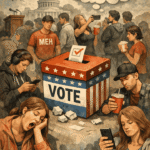
Today, moral language is everywhere. Brands advertise their values. Companies release statements about justice and inclusion. Individuals curate ethical identities online. But notice how often morality becomes performative.
A company may promote diversity while paying poverty wages. A country may celebrate human rights while selling weapons abroad. A person may post the right slogans while benefiting from systems they don’t question. The emphasis shifts from what we do to how we appear.
We feel morally advanced because we are more sensitive to optics. We avoid images that disturb us. We refine language to reduce discomfort. But reducing discomfort is not the same as reducing harm.
Conclusion
So is moral progress a myth? Not entirely—but it’s deeply overstated. What often passes as progress is really a change in aesthetic tolerance. We reject cruelty when it’s obvious, loud, and ugly. But we tolerate it when it’s quiet, bureaucratic, and dressed in professionalism.
The danger of believing too strongly in moral progress is complacency. If we assume we’re already better, we stop questioning what still hurts people beneath the surface. True ethical growth would require not just changing laws or language, but confronting harms even when they are convenient, profitable, or socially acceptable.
Maybe the real question isn’t “Are we more moral than before?”
Maybe it’s: “What kinds of harm are we currently comfortable ignoring?”
Quiz
- What does it mean to say that harm has been ‘aestheticized’ rather than eliminated?
- Why can believing in constant moral progress make societies less self-critical?